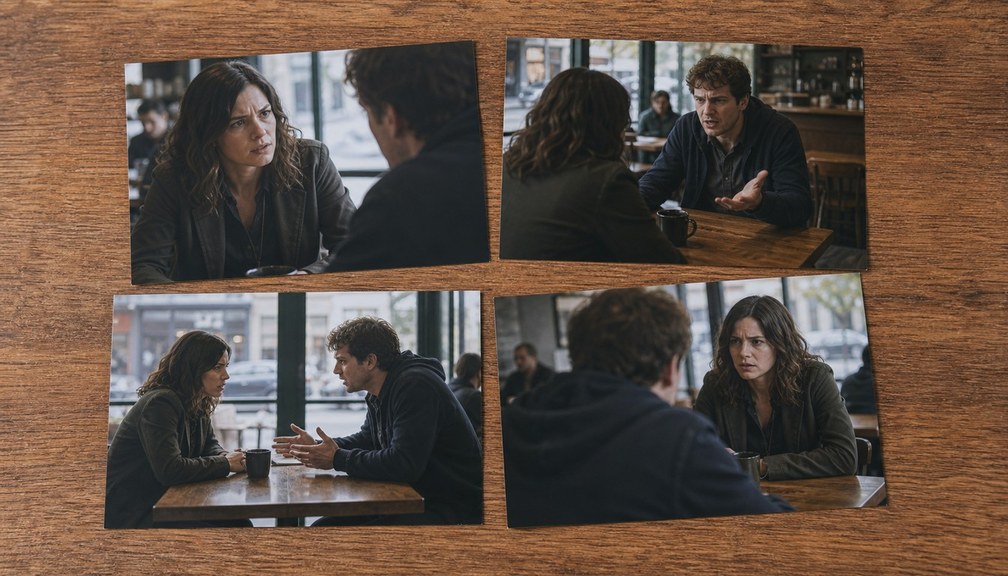
Choose the point of view that gives your particular story the most useful combination of voice, information limits, dramatic irony and narrative distance. Pronouns matter, but they do not settle the decision. The same café argument can keep its characters, actions and ending yet feel entirely different when one participant tells it, another person filters it, or a broader narrator reveals what neither character knows. Treat your first choice as provisional: define what the narration must do, audition the strongest options in one controlled scene and compare their practical effects.
The short version
Choose point of view for its voice, information limits, dramatic irony and distance, not for pronouns alone.
Treat narrator, viewpoint character, knowledge boundary and narrative distance as separate controls.
First person, close third, omniscient third and second person offer different opportunities and costs; none is universally best.
Add another viewpoint only when its access or contrast repays the effort of reorienting the reader.
Rewrite one bounded scene under controlled conditions, then select a provisional winner from the effects you can observe.
What are you really choosing when you choose a point of view?
You are choosing four related controls: who narrates, whose experience filters the scene, what the narration may reveal and how close the prose sits to immediate experience. Start with the narrator, meaning the story-world position and voice doing the telling rather than simply the pronoun on the page. Then name the viewpoint character whose perceptions, vocabulary, assumptions and blind spots shape the moment. In many passages narrator and viewpoint character align closely, but keeping the terms separate makes uncertain drafts easier to diagnose.
Next, write down the knowledge boundary. Mark what may be stated now, what must be inferred from behaviour, what belongs to another character’s private experience and what you intend to withhold. Finally, choose the distance: near bodily sensation and immediate thought, or farther out in summary, reflection, context and commentary. These four controls are an editorial working method, not a universal taxonomy. Their value lies in letting you adjust one element without needlessly rebuilding the rest of the scene.
Narrator: who speaks, and from what position in relation to the events?
Viewpoint character: whose perceptions and language colour this scene?
Knowledge boundary: what may the narration disclose, infer or withhold now?
Distance: how near is the prose to sensation and immediate thought?
Point of view is not the pronoun on the door; it is the system deciding who speaks, who perceives, what becomes known and how close the reader stands.
How do the main point-of-view modes change the page?
The main modes change whose language dominates, which knowledge is available and what kind of pressure the narration must manage. First person places a character narrator’s perceptions, memories, conclusions and blind spots in the foreground. If that narrator recounts an earlier event, decide what the older telling self knows that the experiencing self did not. Close third retains third-person grammar while filtering the scene through one character; other minds remain readable only through outward evidence unless the draft clearly transitions elsewhere.
Omniscient third employs a narrating intelligence able to move beyond one character for context, comparison or dramatic irony. Its freedom still needs a discernible logic, not a switch into whichever mind is convenient. Second person creates a story-world “you” and an address relationship: who is speaking, to whom, and on what occasion? It may produce intimacy, implication, accusation, self-division or resistance, but none of those responses is guaranteed. All four are techniques to practise and revise, not ranks in a hierarchy.
What each narration mode makes available, and what to test in your draft
Narration mode
Reader access
Useful pressure
Cost to test
First person
The narrator’s perceptions, memories, conclusions, language and blind spots.
Makes the teller’s voice and reason for telling difficult to ignore.
Facts outside the narrator’s access must arrive through inference, testimony or discovery.
Close third
One character’s experience in third-person grammar, often coloured by that character’s diction.
Combines a firm character filter with adjustable phrasing and distance.
Other minds must remain externally legible unless a transition is clearly marked.
Omniscient third
A narrating intelligence may range across characters, places, periods, context and commentary.
Creates breadth, comparison, group patterns and dramatic irony.
Movement needs a stable narrating intelligence and a reason the reader can follow.
Second person
A narrator addresses or names a story-world “you”.
Can create direct address, implication, accusation, momentum or estrangement.
The speaker, addressee and occasion must become legible; readers may resist assigned actions.
How close should the prose sit to a character’s experience?
Set the distance according to what the moment needs, independently of whether you use first or third person. Narrative, or psychic, distance is the felt distance between the reader and the events or character experience; it is a craft metaphor, not a physical measure. Broader distance allows time, setting, summary, reflection and narratorial context to enter efficiently. Closer distance tends to foreground character-specific diction, sensation, emotion and less processed thought. Neither setting is inherently more powerful, and readers will not respond identically.
Test distance while keeping the grammatical person and viewpoint character unchanged. In a reserved close-third version, you might report that Naledi waited outside the office and worried about the meeting. A nearer version could select the buzzing light, the damp application form in her grip and the particular phrase she cannot stop rehearsing. The event has not changed; the selection and language have. Remove unnecessary filter phrases where they push the reader farther away, but retain them when the act of noticing or remembering matters.
Move broader when the reader needs elapsed time, setting, context, comparison or reflection.
Move nearer when bodily sensation, character-coloured language or immediate thought should dominate.
Make substantial shifts deliberately; a teaching scale is a diagnostic aid, not a compulsory sequence.
When does an additional viewpoint earn its place?
An additional viewpoint earns its place when it provides indispensable event access, interpretation, contrast or dramatic irony that the existing viewpoint cannot supply efficiently. This decision is separate from grammatical person: a novel may have several first-person narrators or several close-third viewpoint characters. Each filter should notice, interpret and phrase the world distinctly. If two narrators report the same facts in similar voices, the second handoff adds orientation work without giving the reader a meaningful return.
Recasting a scene through a secondary character can reveal different feelings, relationships and neglected material because that character notices and interprets the shared incident differently. Use the rewrite as diagnosis before treating it as structural permission. The alternate version may simply show what the original narrator needs to observe more clearly. If you retain both viewpoints, make transitions legible where necessary. A scene or section break is a common aid, but a chapter boundary is not the only permissible place to change the filter.
Name the information or contrast that only the new viewpoint provides.
Check that its vocabulary, assumptions and blind spots remain distinguishable.
Cut repeated coverage unless the changed interpretation itself creates value.
Make each handoff clear enough that orientation does not smother momentum.
How do you audition viewpoints without changing the story underneath?
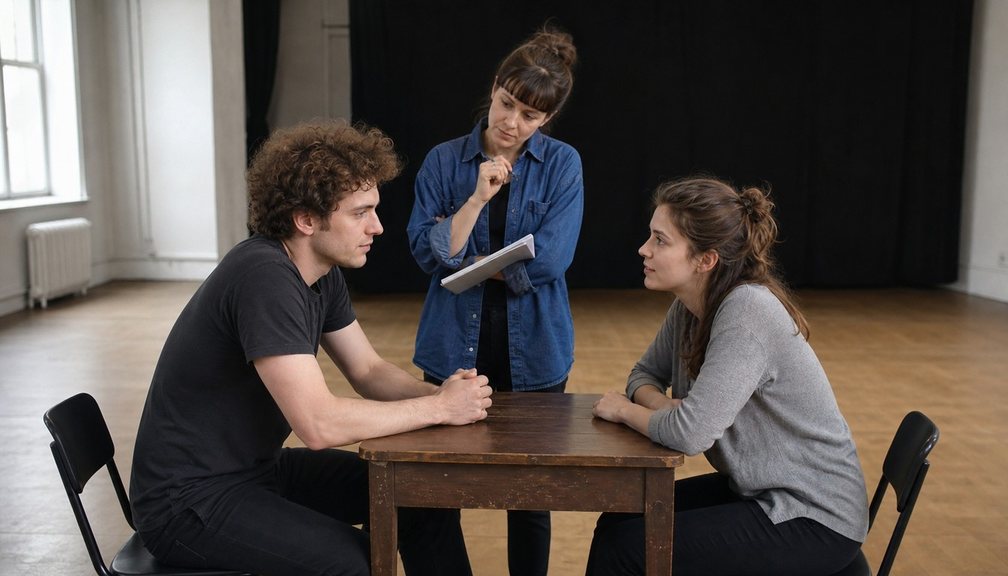
Run a fair audition by rewriting one bounded scene while holding its underlying action steady. Choose an encounter in which two characters want different things, someone performs at least one concrete action and one relevant fact remains unspoken. Keep the setting, conflict, desires, tense, endpoint and approximate length unchanged. Aim for roughly 250 words per version: MIT’s source exercise uses no more than 200 words, while this editorial adaptation leaves room for additional distance, omniscient and address tests.
Do not repair the plot halfway through the audition. A clever new revelation, extra backstory or changed ending could make a later version appear stronger for reasons unrelated to point of view. Put discoveries in a separate note and revise the underlying scene only after all six attempts are complete. This is not laboratory research, but the controlled conditions make differences in voice, access, concealment and distance easier to see than six unrelated examples would.
Write first person from character A, deciding whether the narrator experiences the scene now or recounts it later.
Write close third from character A at a moderately observant distance.
Bring that close-third version nearer through sensation, immediate thought and character-coloured diction.
Write omniscient third with a clear reason for the narration to move beyond character A.
Write second person and define who says “you” to whom, even if the occasion remains implicit.
Write first person or close third from character B while preserving the same external incident.
Read the versions side by side rather than relying on how each felt while drafting. Underline language that could belong only to that narrator, circle facts newly available to the reader and mark moments where information now has to be withheld or awkwardly delivered. Note where dramatic irony appears, where the prose naturally moves nearer or farther, and where an offstage event becomes difficult to handle. The point is to expose gains and costs, not to award marks for technical ambition.
How do you choose a provisional point of view from the audition?
Choose the version whose gains best serve the whole story and whose costs you can manage without repetitive workarounds. Distinctive language matters, but so do necessary knowledge, useful concealment, dramatic irony, distance and transitions. Ask whether the voice could sustain quiet connective passages as well as the audition’s tense encounter. If important events repeatedly occur outside its knowledge boundary, decide whether indirect discovery creates productive tension or merely forces characters to deliver implausibly convenient reports.
Which version produces language only this narrator or viewpoint character could plausibly use?
Which necessary facts become available, and which useful facts stay concealed?
Does the distance suit this moment without trapping later scenes at the same setting?
Can transitions and offstage events be handled without constant explanation?
If you add a viewpoint, what indispensable access repays every handoff?
Treat those questions as notes, not a numerical test. A scorecard cannot prove artistic superiority, and a successful short scene does not guarantee a sustainable novel. Select a provisional winner, revise it as a complete scene and continue for enough pages to reveal recurring strain. Reopen the decision if the voice becomes monotonous, handoffs remain confusing or the knowledge boundary repeatedly blocks essential events. Do not reopen it merely because another mode offers a few attractive sentences; every choice sacrifices something.
The strongest practical choice is usually the one that creates useful pressure rather than the one that removes every difficulty. A limited narrator may make discovery suspenseful; a broader narrator may create irony by showing what characters miss. Once you can name that benefit and its cost, commit long enough to test the design honestly. Point of view remains revisable, but a provisional decision gives the draft a coherent voice, perceptual filter, knowledge boundary and distance from which to grow.
Frequently asked questions
How do I choose a point of view for a story?
Compare who narrates, whose perceptions filter each scene, what the narration may know and how close it sits to experience. Rewrite the same bounded scene in your leading options, then choose provisionally according to voice, useful concealment, dramatic irony and sustainability.
Should I write fiction in first person or third person?
Use first person when a character narrator’s language, conclusions and reason for telling create useful pressure. Use close third when you want one character’s filter with third-person grammar and flexible distance; neither mode is automatically closer, easier or more reliable.
What is the difference between close third and omniscient third?
Close third filters a scene through one viewpoint character, leaving other minds externally legible until a clear transition. Omniscient third uses a narrating intelligence that can move beyond one character, but its movement needs a discernible voice and logic.
Should a novel have one viewpoint or several?
Add a viewpoint only when it supplies indispensable access, interpretation, contrast or dramatic irony. Its voice must remain distinguishable, and the value it adds should repay the orientation and momentum cost of each handoff.
What is narrative distance in fiction?
Narrative distance is the felt distance between the reader and story events or character experience. Summary and context often broaden it, while sensory detail, immediate thought and character-coloured language can bring the prose nearer without changing grammatical person.
References & Sources
This article was researched using the following sources:
We write the reading guides we wanted and could not find. Our recommendations lean on reputable sources and bibliographic records, and we say plainly when something is a matter of taste. AI assists with research and drafting, and every guide is checked against its sources before it goes out.
A practical way to separate what you loved about a book, rank the qualities that matter now and turn them into a precise read-alike request for your next read.