On your first page, do five things: check which direction the edition expects you to read, scan how the panels are grouped, follow balloons towards their likely speakers, connect each panel to the next using only what the story shows, then glance back over the page as a whole. That routine is enough to begin. You need not inspect every background detail or memorise specialist terms before the story can move. If a later image changes your first interpretation, simply look back and adjust it; that movement is part of reading the form.
The reading loop at a glance
Check the edition’s intended direction before treating any route across the page as the default.
Infer the smallest bridge supported by adjacent panels and the surrounding story.
Read balloons, captions, sound effects and pictures together, checking each convention against the work itself.
Use scale, density, repetition, silence, framing and content together when judging pace.
Treat looking back and scanning the whole page as ordinary parts of comics reading.
Where should your eyes go first?
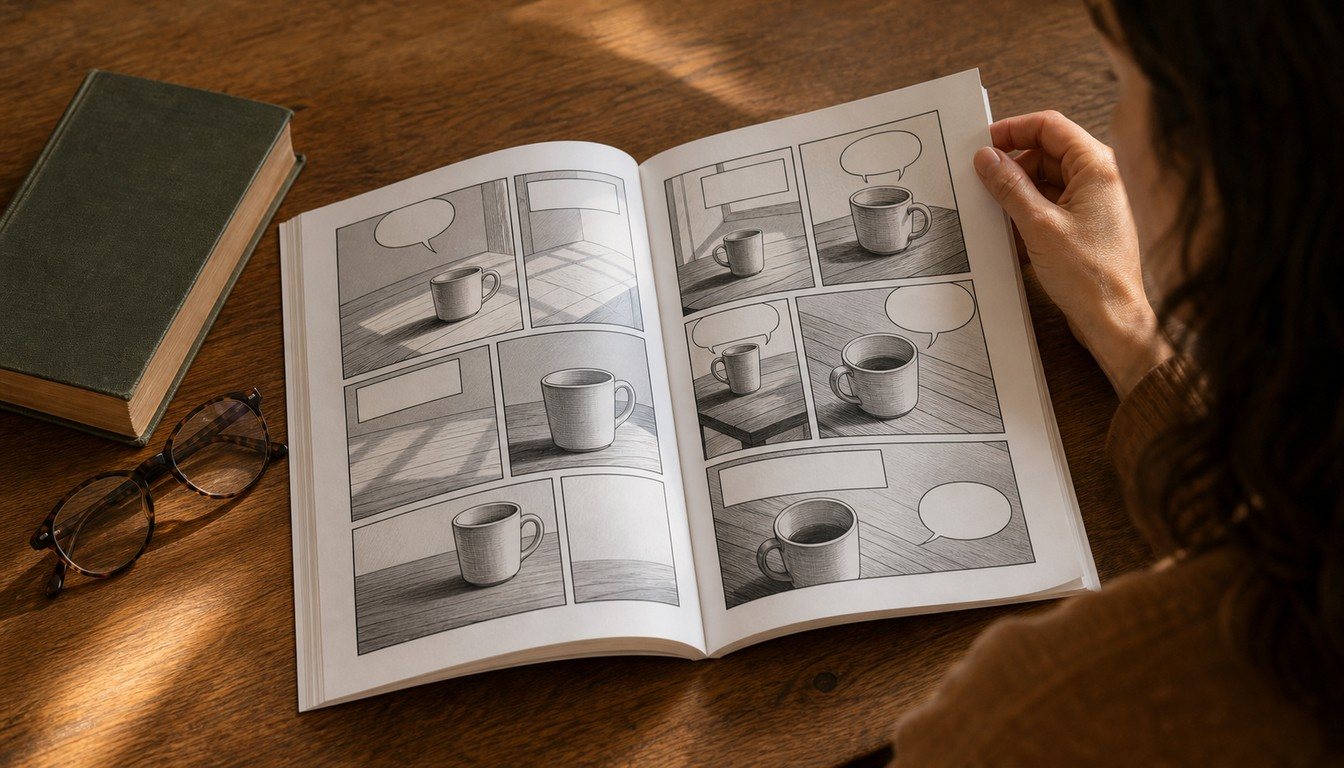
Start with the edition’s stated reading direction, then scan the panel groupings before choosing a route. On a conventional left-to-right page, moving across the upper grouping and then down is a useful starting pattern. Many manga editions retain right-to-left reading, so reverse that expectation when instructed. Borders, rows, columns and broad gaps can suggest which panels belong together, while overlaps, insets or a dominant image may require you to pause and inspect the relationships rather than force a tidy grid onto the page.
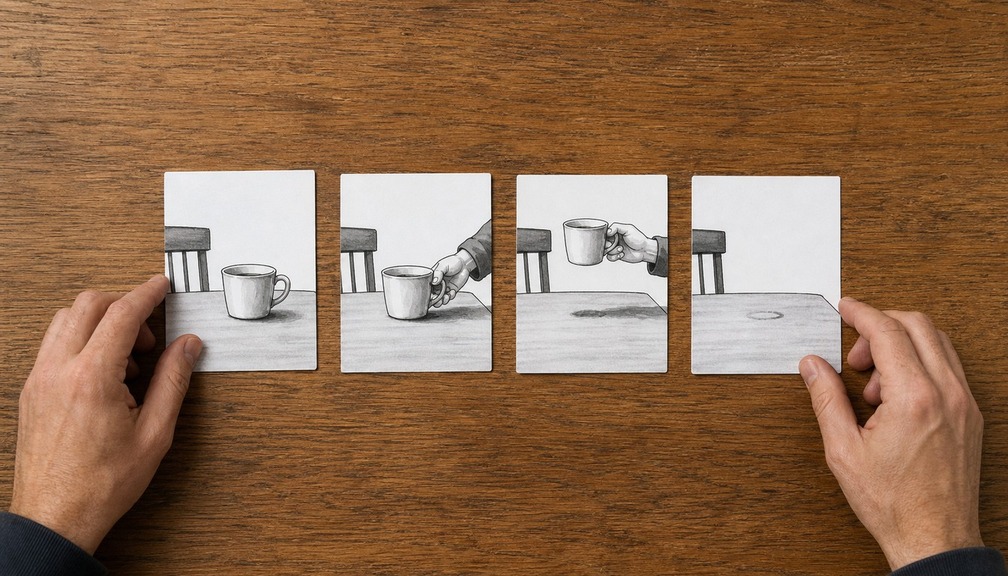
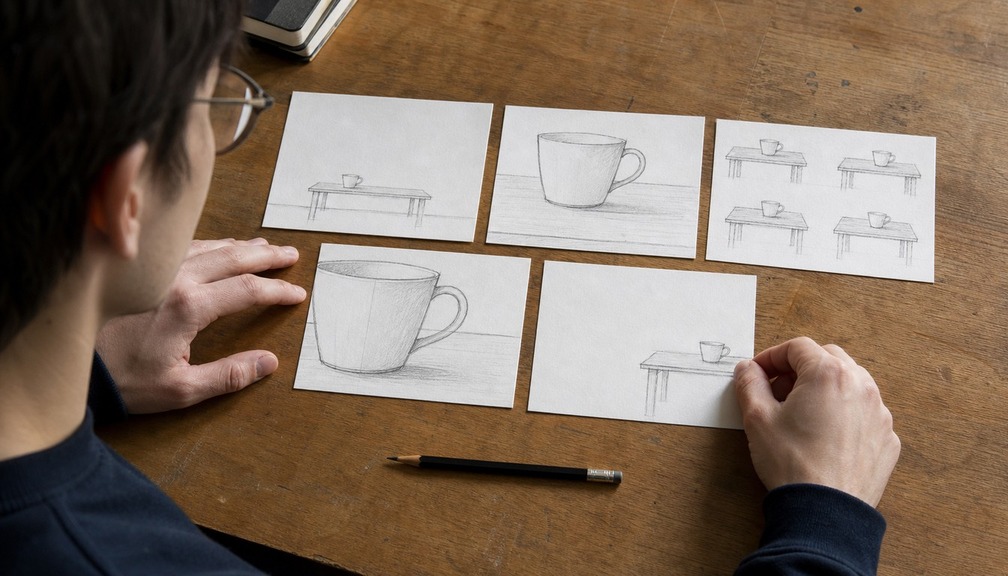
Try that approach with four wordless cards: a wide view of two people at a table with a cup near the edge; an arm reaching past it; the cup on the floor with liquid spreading; and a figure reaching for a towel. Establish that order before deciding exactly what occurred. Within an uncertain grouping, balloon position and conversational turn-taking may help, but neither should override a direction note or a strong visual link, such as a gesture that clearly continues into the neighbouring panel.
No route works perfectly for every comic. A corpus analysis of 60 selected comics found systematic differences in page arrangements across the traditions it sampled. A 2025 eye-tracking study of 90 novice and experienced readers using one textless Watchmen page found that a Z-shaped left-to-right route described the aggregate pattern reasonably well, yet individual paths varied and returns to earlier panels were common. These findings make the conventional route a prototype, not a pass-or-fail rule.
What happens between one panel and the next?
Read the change between panels by comparing what is visible before and after, then infer only the smallest bridge the evidence supports. Each panel is a selective frame of attention: it might establish the room, isolate a person, bring one object close, show an action or present a result. Across a sequence, those frames can establish a situation, initiate an event, reach a culmination or show a reaction, but they do not have to follow that pattern or assign one objective instant to every box.
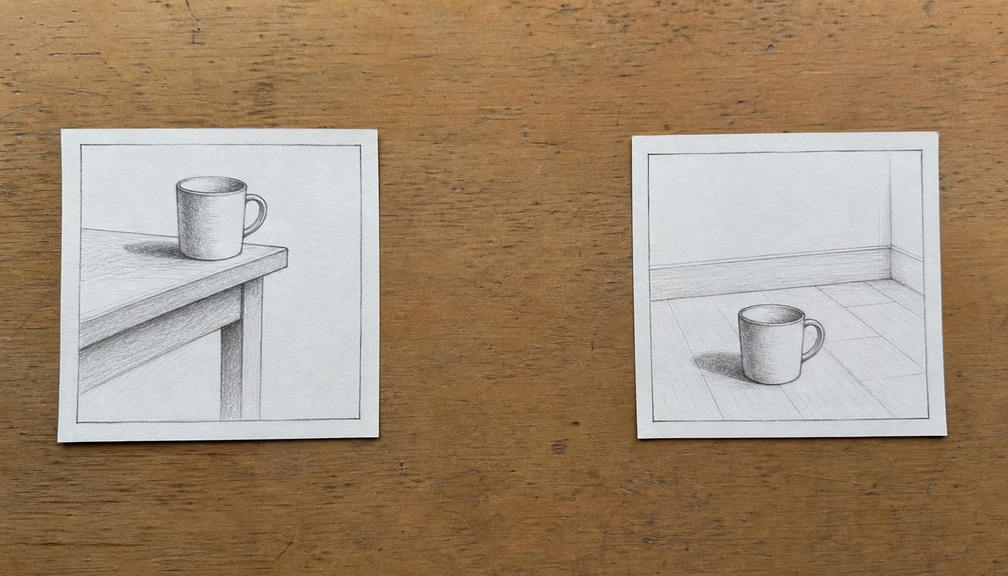
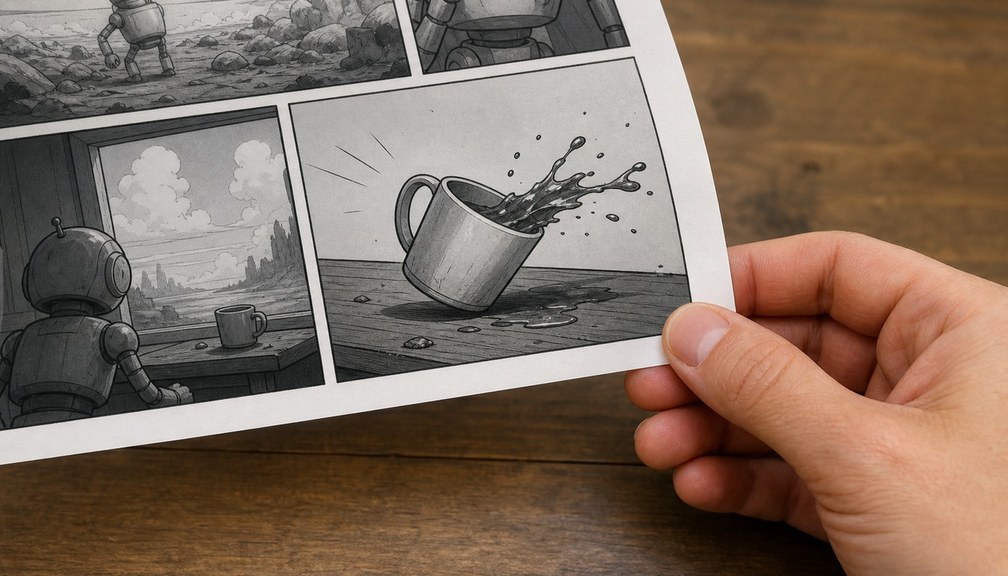
In the cup sequence, one panel places the cup near the table edge and a later panel shows it on the floor amid spreading liquid. The restrained bridge is that the cup fell or was knocked down. You cannot yet say who caused it, whether it was deliberate or what anyone intended. Visual-narrative research describes this kind of evidence-bound reconstruction as a bridging inference: surrounding cues allow the reader to connect an omitted event, while the depicted scene and wider story constrain the possibilities.
The gutter is simply the visible space between panels; it does not carry one fixed duration or meaning. Adjacent images might mark movement, elapsed time, a change of viewpoint, a new place, a contrast or a reaction. Some panels even touch or overlap, leaving little visible gap while still forming a sequence. Ask what changed, what remained continuous and what the story requires you to supply. If the evidence stays ambiguous, keep more than one possibility open.
Read for clarity first; let the page teach you its grammar.
How do balloons, captions and sound effects guide you?
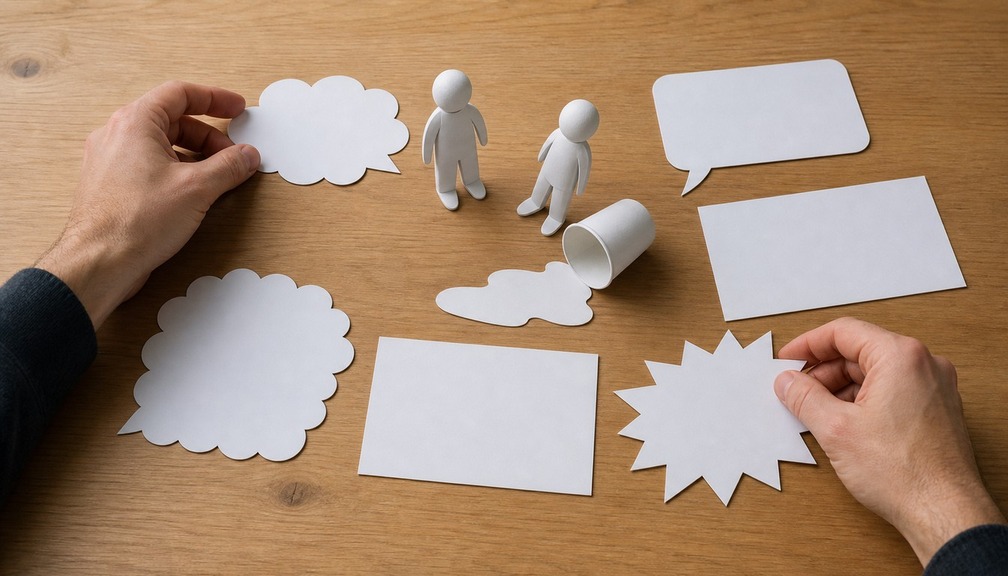
Identify the text form, trace any tail or trail towards its likely source, and test that reading against the scene. A rounded balloon connected to someone at the table will usually suggest speech; a caption may address the reader, supply narration or present internal language; lettering beside the fallen cup may represent its impact. Faces, gestures, turn-taking and what each character could plausibly know help confirm the connection. The words and pictures work together, so an image may locate, qualify, extend or contradict what the lettering says.
Treat shapes and type styles as clues rather than a universal code. A jagged border, heavier lettering, a cloudlike form or an altered tail may suggest loudness, thought, distress, transmission or a particular kind of sound, but creators and editorial traditions vary. The same shape can perform different jobs in different books. Once you notice a work’s recurring choices, use them consistently while remaining alert to deliberate exceptions—especially when the scene’s expressions, staging or conversational sense point somewhere else.
Common lettering clues and the evidence that should confirm them
Text form
Visible cue
Likely function
What context must confirm
Speech
A balloon with a tail aimed towards a figure
Words spoken within the scene
The speaker’s position, expression and conversational turn
Thought
A cloudlike carrier or a trail of smaller shapes
Private language associated with a character
Whose perspective the scene follows and whether others respond
Narration or internal caption
A box or floating text without a speech tail
Narration, framing information or inward language
Voice, tense, viewpoint and the caption’s relationship to the image
Off-panel or transmitted voice
A tail leading beyond the frame or a distinct border style
Speech from outside the view or through a device
Where the voice could originate and how characters react
Sound effect
Free-standing, shaped or emphatic lettering within the scene
An environmental sound made visually present
The nearby action, object, scale and character responses
How does the page shape emphasis and pace?
The page shapes emphasis by selecting what each frame shows and arranging paths for your attention. A wide view of the table establishes people, objects and space; a close view makes the cup at the edge harder to ignore. Within a panel, follow gazes and gestures, then notice foreground and background placement, repeated shapes and where the lettering sits. A character looking towards the cup can direct you across the image, while the cup’s repeated outline can connect panels even as the framing changes.
Felt pace comes from several cues working together, not from a conversion between panel size and seconds. More frames can divide an action into smaller stages; repetition can hold attention on a result; a nearly empty panel can foreground silence; and a dense combination of images and words can ask for closer inspection. Content and reader attention remain part of the effect. A repeated view of spreading liquid may prolong attention without proving exactly how long the spill takes within the story.
Read unusual arrangements as relationships to interpret in context. In a 60-book corpus, the sampled comics varied in vertical and horizontal segmentation, bleeds, whole-row panels, staggering, separation and overlap. That range is a reason to examine what a dominant image, inset or borderless area is doing on its particular page, not to assign each device a fixed command. After following the sequence, step back mentally and ask which image dominates, which shapes echo and where the composition leaves your eye.
What makes a page turn feel like a reveal?
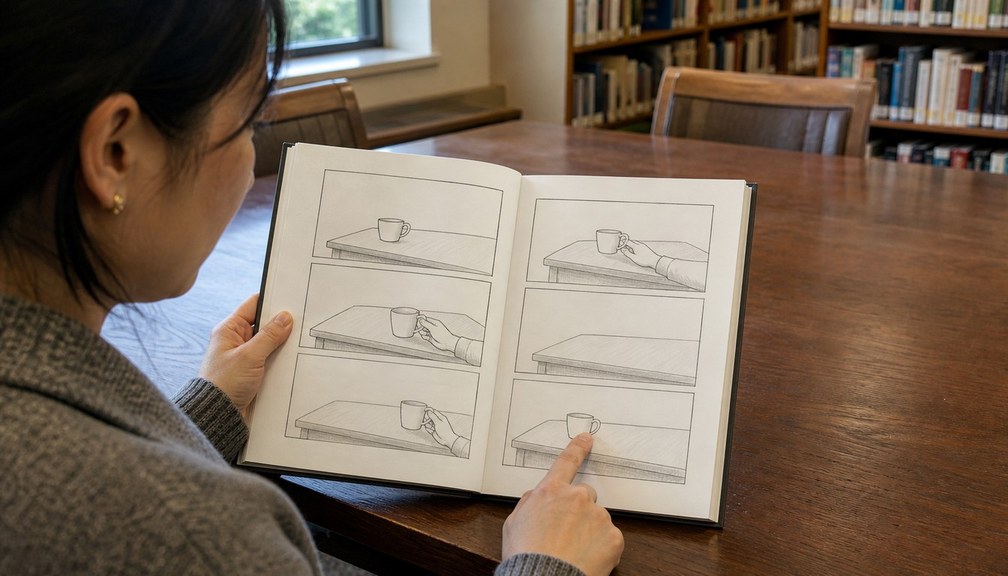
A printed page turn creates a reveal when the current page sets up a question and physically conceals the answering image. End the cup page with the vessel tipping at the table edge, and place the fallen cup plus the characters’ reactions on the next page. The reader cannot see that result until the sheet turns, so the action of advancing becomes part of the delay. The device can create suspense, surprise or simple curiosity, but it does not prescribe one emotional response.
The same principle—control what becomes visible and when—changes with the format. A two-page spread may expose both pages together, turning the seam and open spread into one composition rather than a secure hiding place. A swipe, guided-view transition or vertical scroll can delay information too, but each uses a different boundary. Look at the final visible beat and ask what it withholds. Pause if you sense a setup, but do not assume that every last panel is a cliffhanger or that suspense requires a calculated delay.
When should you look back at the page?
Look back whenever later information changes the route, speaker or action you first understood, and make one brief second pass after the sequence is clear. On the first pass, prioritise direction, voices and visible changes. On the second, revisit the cup before and after the fall, check any uncertain speaker, and notice repeated shapes, character gazes, background continuity, silence and framing shifts. This separates basic comprehension from closer attention, so detail can enrich the reading without blocking your progress.
Finish with a whole-page glance. Comics comprehension brings narrative sequence, page layout and framed attention into contact, so the local meaning of a panel may become clearer when you see its place in the larger composition. Check whether the final beat prepares a turn, spread, swipe or scroll, and whether an earlier image now reads differently. Eye-tracking participants commonly returned to previous panels, although the research does not assign every backward movement the same purpose. Looking back is therefore compatible with observed reading, not evidence that you have failed.
Keep the routine light enough to use. Follow clarity first, revise an uncertain connection when new evidence arrives, and allow the vocabulary of panels, gutters, lettering and reveals to become familiar through reading. Some pages will guide you immediately; others will reward a slower scan. Neither experience is the correct one in isolation. The useful question is whether your interpretation accounts for the edition’s direction, the visible sequence, the words and pictures, and the page’s larger design.
Questions about reading comics
How do I know which comic panel to read first?
Check any direction note supplied by the edition, then scan the borders, rows, columns, gaps and overlaps. English-language pages commonly begin at the upper left, while many manga editions read from the upper right. Treat that convention as a starting point and use clear visual relationships or dialogue context to resolve exceptions.
What are gutters in comics?
Gutters are the visible spaces between panels. Their size does not automatically tell you how much time passed or what kind of change occurred. Compare the adjacent images and story context to decide whether you are seeing motion, elapsed time, a new viewpoint, a different place or another relationship.
How do I tell which speech balloon comes first?
Begin with the page’s intended reading direction and compare the balloons’ relative positions. Trace tails towards speakers, then test the order against turn-taking, expressions and conversational sense. If those cues conflict, the surrounding scene may reveal that the work is deliberately varying the usual arrangement.
How do comics tell stories without showing every action?
Panels select particular views rather than displaying every stage of an event. If one panel shows a cup near the table edge and the next shows it on the floor, you can infer that it fell or was knocked down. Stop there unless the images or wider story identify a cause, culprit or intention.
Why do comic page turns create suspense?
A printed page can pose a question in its final visible panel and conceal the answer until you turn the sheet. That delay makes advancing the page part of the reveal. Spreads, guided view, swipes and vertical scrolling control visibility differently, so their suspense depends on their own boundaries rather than a physical page edge.
References & Sources
This article was researched using the following sources:
We write the reading guides we wanted and could not find. Our recommendations lean on reputable sources and bibliographic records, and we say plainly when something is a matter of taste. AI assists with research and drafting, and every guide is checked against its sources before it goes out.
A practical guide to testing first person, close third, omniscient and second person through voice, knowledge, distance and a controlled scene rewrite.