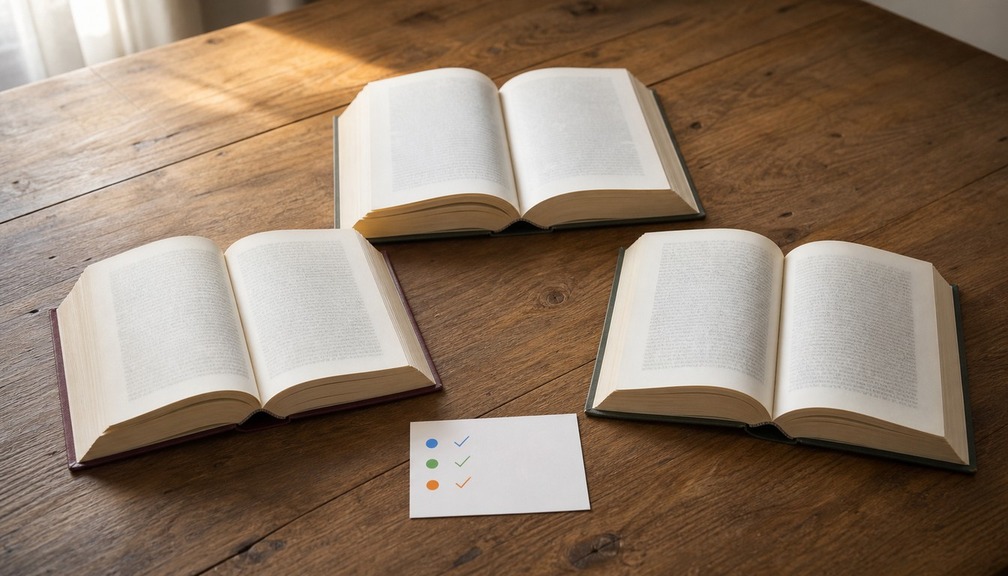
Choose a translation for the reading you want now, not as a winner for every reader and every encounter with the work. Start by confirming which translation an edition actually contains and whether it is complete. Then decide whether you chiefly want narrative ease, conspicuous source-language texture, poetic or dramatic form, study support, performance value or comparison with the original. Inspect the translator's stated method and the edition's notes, then compare the same three revealing passages in two or three candidates. The strongest choice is the verified edition whose benefits and compromises suit that purpose.
The decision in brief
Choose for the purpose of this reading rather than searching for a permanent winner.
Verify the translator, original translation date, revision status, completeness, edition date and format before comparing samples.
Judge fidelity through meaning, voice, ambiguity, imagery, repetition, syntax, register and form, not literalness alone.
Compare an opening, a character-driven scene and a difficult passage, recording both the benefit and cost of each version.
Use samples to assess the reading experience, not to certify accuracy against a source language you cannot read.
What should you settle before comparing translations?
First, define your purpose and verify the identity of each edition. A first reading may favour momentum and immediate clarity, while a university module may require substantial notes, and a dramatic reading may make cadence or speakability decisive. Write that priority in one sentence before looking at samples. It prevents attractive covers, confident blurbs and vague claims such as “definitive” from quietly replacing the decision you meant to make.
Named translator and the translation's original publication date
Date of the edition in your hand and any stated revision history
Complete, partial, abridged or adapted status
Prose, verse, verse drama or another declared format
ISBN, publisher record and title or copyright-page details
Do not assume that a recent printing contains a recent translation. The Same Passage describes checking publisher and library records against physical copyright pages and labelling the confidence of each match; that is a useful model for separating evidence from guesswork. If a book is abridged, adapted, revised, partial or unattributed, treat that as a distinct option. It may fit your purpose perfectly, but it is not interchangeable with a verified, complete translation by a named translator.
Does a newer date mean a better translation?
No: publication date is useful metadata, not a quality score. Separate the translation's first appearance from a later reprint, revision or newly designed edition. A University of Edinburgh research overview identifies several possible reasons for retranslation, including refreshed language, changed norms, corrections, a different interpretation and access to a newer or sometimes more complete source edition. Those possibilities tell you what to investigate; they do not establish that a particular new version is better.
Read the translator's preface, publisher description and reliable criticism for a declared aim, then look for that aim in the text. A newer version may seek contemporary idiom, while an older one may remain valuable for its voice, historical influence or formal approach. Brian Nelson's account of retranslating Proust rejects the notion of an ultimate translation and discusses competing choices about voice, idiom and source-language strangeness. Ask what changed, why it changed and whether the result helps this reading.
What do fidelity and readability mean on the page?
They are bundles of observable choices, not single qualities that can be measured with one label. Lawrence Venuti describes literary translation as partial interpretation and the translator as a writer rather than a transparent conduit. That makes it more useful to ask what a version does with meaning, voice, ambiguity, imagery, repetition, syntax, register and form. “Faithful” means little unless a reviewer names the responsibility being discussed and the evidence for that judgement.
Meaning: does a loaded term stay consistent, or change with context?
Voice: do narrators and characters sound distinct in register and temperament?
Texture: are repetitions, images, ambiguities or unusual constructions visible?
Movement: do sentences or lines feel brisk, ceremonial, compressed or expansive?
Clarity: what becomes immediately intelligible, and what nuance may be simplified?
The Open University's comparison of English versions of a Homeric passage shows why word-for-word order is an inadequate test: words carry ranges of meaning, and Greek and English organise syntax differently. Smooth English and visible source-language strangeness are therefore competing priorities that may preserve different features, although a translation can combine them from passage to passage. If you cannot read the source, neither fluency nor awkwardness alone proves accuracy. Record the experience honestly and leave source-based conclusions to stronger evidence.
Should you choose verse or prose for poetry, epic or drama?
Choose the form that foregrounds what you want to experience; neither verse nor prose is universally superior. Inspect whether the version uses continuous prose, verse, verse drama, matched line counts, a recurring metre or freer lineation. Verse can make rhythm, line endings, repeated structures and performance choices conspicuous. Prose can support continuous narrative or conceptual movement. These are tendencies to test in the actual book, not guaranteed results of a label on its cover.
Reading aloud is particularly revealing for epic and drama. Listen for breath, emphasis, awkward clusters, comic timing and whether different speakers possess different verbal energy. The Open University notes that languages organise rhythm differently, so recreating a source metre in English may produce a different effect rather than restoring an original audience's experience. Penguin's work-specific guide to The Odyssey usefully distinguishes prose, verse, verse drama and adaptation, but its promotional preferences should not be treated as neutral rankings.
Match your priority to evidence you can observe
Reader priority
Signals to look for
Likely tradeoff
Narrative momentum
Clear orientation, manageable sentences and sustained forward movement
Some formal difficulty or source texture may become less visible
Poetic or dramatic sound
Purposeful rhythm, line endings, repetition and speakable phrasing
Syntax or pacing may feel less conversational
Study support
Relevant notes, bibliography, chronology, glossary and textual explanation
Apparatus may interrupt an immersive reading
Visible source texture
Unusual syntax, recurring terms, ambiguity and culturally specific detail
The English may demand slower, more attentive reading
Performance
Distinct voices, audible cues, workable breath and dramatic pace
A performance-led version may reshape formal or explanatory detail
How much explanatory material should an edition provide?
Choose enough apparatus to answer your likely questions without repeatedly breaking the reading experience you want. Oxford World's Classics lists introductions, explanatory notes, chronologies, bibliographies, maps, glossaries, indexes, illustrations and appendices among the materials an edition may provide. Inspect the actual contents rather than treating “annotated” or “scholarly” as a complete description. Check what the notes explain, where they appear and how often consulting them pulls your attention away from the main text.
For orientation, look for a concise chronology, map or cast list.
For close study, inspect note density, bibliography and discussion of textual variants.
For uninterrupted reading, favour apparatus that is easy to postpone or ignore.
For comparison, seek a clear translator's account of method and recurring terminology.
Keep two kinds of introductory material distinct. A translator's preface may explain interpretive and stylistic choices; Venuti recommends it for precisely that reason. A critical introduction may instead emphasise context, reception, argument or interpretation. Either can disclose plot developments, so translator-authored does not mean spoiler-free. If that matters, inspect the contents page or publisher description first and defer an introduction whose scope is unclear. Notes can also carry cultural or linguistic information that a translated line cannot hold by itself.
How can you compare translations without reading them all?
Use the same three passages in two or three verified candidates and make brief, descriptive notes. This is a practical editorial procedure, not a validated formula, so adapt the selections to the work. The Same Passage fixes an opening, a set piece and a famous crux at matching structural locations. A broader reader-led version can test baseline voice, character or emotional register, and whatever formal or conceptual problem is most distinctive in the classic you are considering.
Compare the opening for narrative voice, sentence movement, lineation and immediate clarity.
Choose dialogue or an emotionally charged scene to test character voice, register, tone and morally or socially loaded terms.
Choose a difficult passage involving argument, ambiguity, comedy, chorus, wordplay, repetition, terminology or demanding poetic form.
For every passage, note voice, clarity, rhythm or form, repeated terms and the usefulness of any notes. Write one benefit and one cost for each version: “energetic dialogue, but distinctions in register seem narrower” is more useful than a score without reasons. Compare the translator's declared method with what the samples demonstrate, while keeping intention and execution separate. A matched passage can reveal meaning, syntax, metre and explanatory choices, but a short sample cannot represent every decision across a long work.
Without the source language, you can still judge whether a voice engages you, whether the prose or verse is clear enough for your purpose, whether repetitions remain visible and whether the apparatus answers useful questions. You can also check consistency across your selected passages. What you cannot certify from those samples alone is accuracy against the source. For coursework, publication or a source-dependent argument, add specialist criticism or advice from someone qualified in the relevant language and textual tradition.
The best translation is the verified version whose visible tradeoffs fit the reading you want now.
What is the final decision rule?
Choose the verified version whose declared priorities and demonstrated tradeoffs best match your stated purpose. Eliminate candidates that fail the required scope: an abridgment when you need the complete work, for example, or an apparatus-heavy edition when uninterrupted reading is your main aim. Among the remaining books, combine your passage notes with your preferred form, tolerance for explanatory material and confidence in the bibliographic record. Do not let a numerical score conceal the reasons behind it.
Name the purpose: first reading, study, rereading, performance or source comparison.
Name the observed benefit: voice, clarity, form, texture or useful apparatus.
Name the accepted cost: slower pace, reduced texture, interruption or greater difficulty.
Keep the alternative that serves a different future purpose.
State the choice in purpose-and-tradeoff language: “This edition suits my first reading because its narrative movement is clear and its notes are easy to postpone, though another version makes the verse form more audible.” That is a stronger conclusion than “best translation” because it identifies both evidence and limits. A reread, class, formal performance or comparison with the source may justify another choice later. Where a decision depends on textual history or the original language, consult the relevant lecturer, editor, director, librarian or source-language specialist.
Frequently asked questions
How do I choose a translation of a classic?
Define the purpose of this reading, then verify the translator, original translation date, revision status and completeness of each edition. Inspect its form, notes and translator's account of method before comparing the same opening, character-driven scene and difficult passage in two or three candidates. Choose the version whose observed gains and compromises best fit your purpose.
Is a newer translation usually better than an older one?
No. A retranslation may refresh language, reflect changed norms, correct perceived problems, offer another interpretation or use a newer source edition, but none of those motives guarantees a better result. Treat date as a prompt to investigate the translator's aims and the text, not as an automatic score for accuracy or readability.
Is a literal translation more faithful?
Not necessarily, because words have ranges of meaning and languages organise syntax, rhythm, connotation and cultural knowledge differently. Ask what the translation preserves or changes in meaning, voice, ambiguity, imagery, repetition, register and form. Word-for-word order is only one feature and may not produce equivalent meaning or effect.
Should I read a verse or prose translation?
Choose according to the experience you want. Verse may foreground rhythm, line endings, repetition and performance, while prose may encourage continuous narrative or conceptual movement, but neither outcome is automatic. Read more than one passage aloud and note what each form clarifies, intensifies or makes harder to follow.
Can I judge a translation if I do not know the original language?
You can compare voice, clarity, rhythm, form, consistency, declared method and the usefulness of notes. Those observations can identify the version that best serves your reading. They cannot, by themselves, certify accuracy against the source, so source-dependent academic or editorial conclusions need suitable specialist evidence.
References & Sources
This article was researched using the following sources:
We write the reading guides we wanted and could not find. Our recommendations lean on reputable sources and bibliographic records, and we say plainly when something is a matter of taste. AI assists with research and drafting, and every guide is checked against its sources before it goes out.