How to Read Comics: Panels, Gutters and Page Turns
A practical guide to following comic panels, bridging gutters, reading lettering, sensing visual pace and understanding reveals across print and screens.
On a first page, do five things in order: check which direction the edition expects you to read, scan the panel groupings, follow each balloon towards its likely speaker, connect one panel to the next using only visible evidence and story context, then glance back over the complete page. That routine gives you the route and the essential action before you start examining every expression, background object or flourish of lettering.
Comics ask you to read sequence, words and composition together, but they do not hide a single secret code. A difficult arrangement may invite you to pause, test a route and revise it when a later image clarifies the scene. That is ordinary reading, not a mistake. Work for clarity on the first pass; on the second, notice how the page directs attention, withholds information and makes separate moments feel connected.
The reading method at a glance
Check the edition’s intended direction before treating any route as the default.
Infer the smallest bridge supported by adjacent panels and the surrounding story.
Read balloons, captions, sound effects and images together, then test their cues in context.
Treat scale, density, repetition, silence, framing and content as interacting pacing cues.
Look back whenever new information changes how you understand an earlier panel.
Where should your eyes go first?
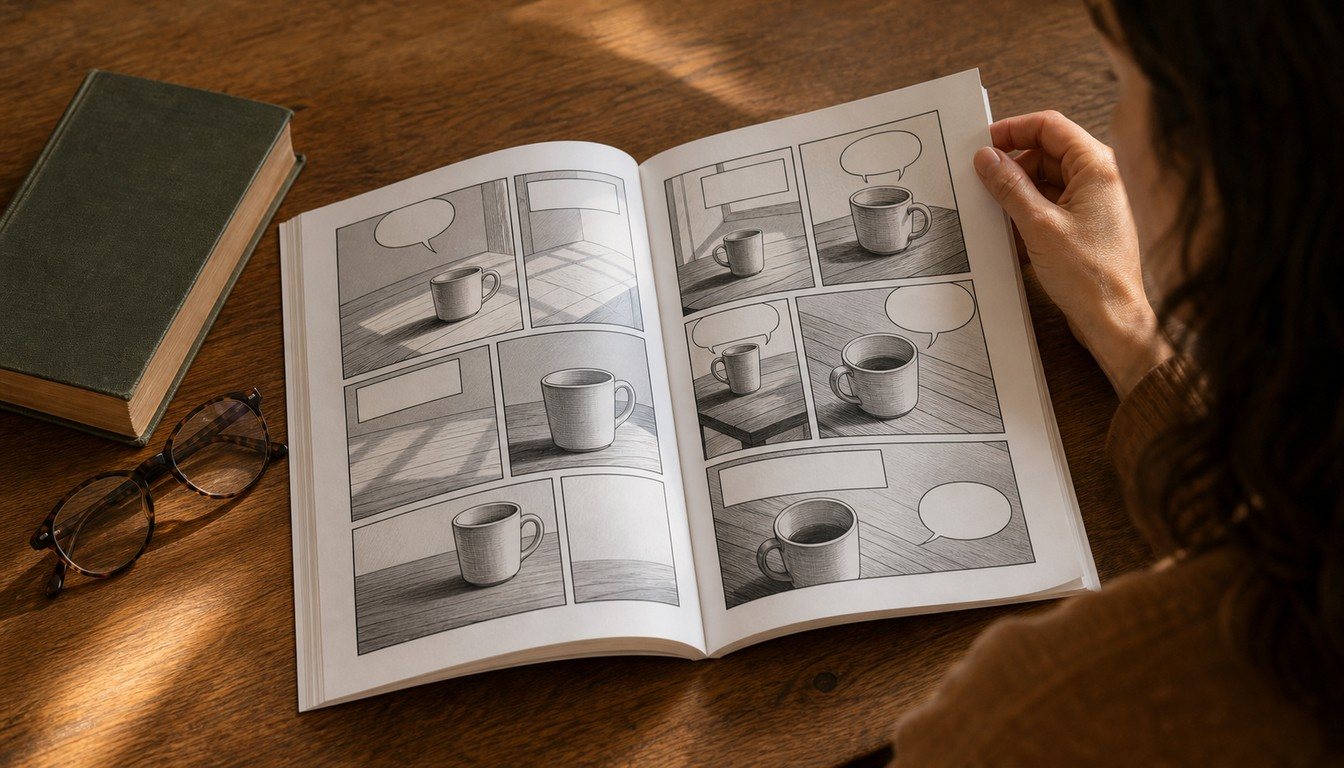
Start with the edition’s stated reading direction, then scan the borders, rows, columns, gaps, overlaps and dominant images before choosing a route. On a conventional left-to-right page, the upper-left panel and a movement across the top grouping before descending provide a useful starting pattern. Many manga editions retain a right-to-left route, so reverse that expectation when the book instructs you to do so. Clear visual relationships take priority over habit.
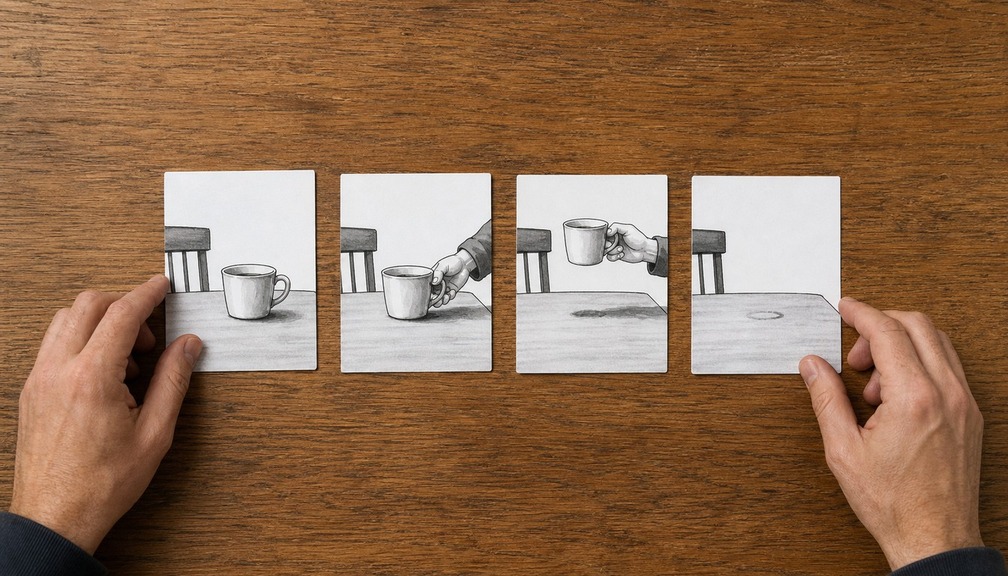
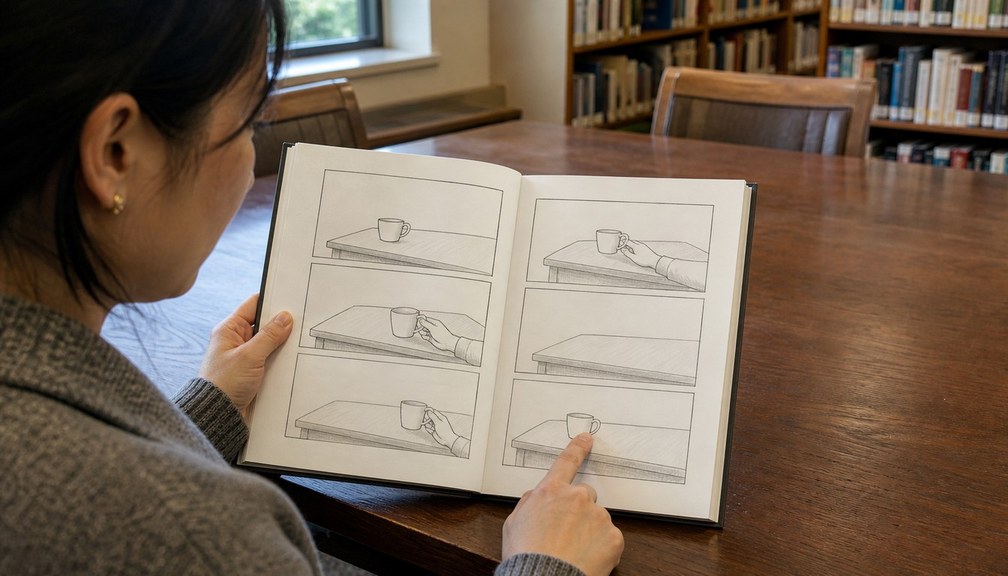
Try the route on four imagined panels: two people sit at a table beside a cup; an arm reaches past it; the cup appears on the floor amid spreading liquid; someone reaches for a towel. Establish that order before deciding exactly what happened. If two balloons compete for attention, their height, tails and conversational sense may settle the sequence, but dialogue cannot overrule the edition’s direction or an unmistakable visual connection between panels.
Research supports using a common route as a prototype rather than a law. A 2025 eye-tracking study followed 90 novice and experienced readers viewing one textless Watchmen page: aggregate movement broadly fitted a Z-shaped left-to-right path, yet individual routes varied and returns to earlier panels were common. A separate corpus of 60 comics also found systematic layout differences across its sampled traditions. Begin with convention, therefore, but let the particular page correct you.
What happens between one panel and the next?
Between panels, infer the smallest change that makes the visible states connect. Each panel frames attention: it might establish the room, isolate a hand, show an action, stress a detail or present a result. Those functions can resemble setup, initiation, culmination and reaction, but they are questions to ask rather than a four-panel formula. A comic may omit one role, repeat it or spread it across several images.
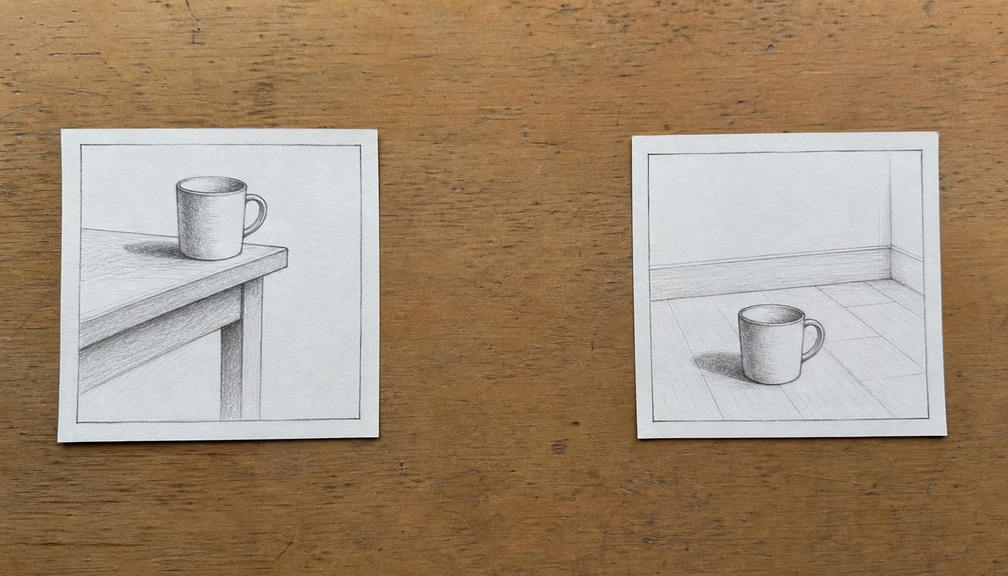
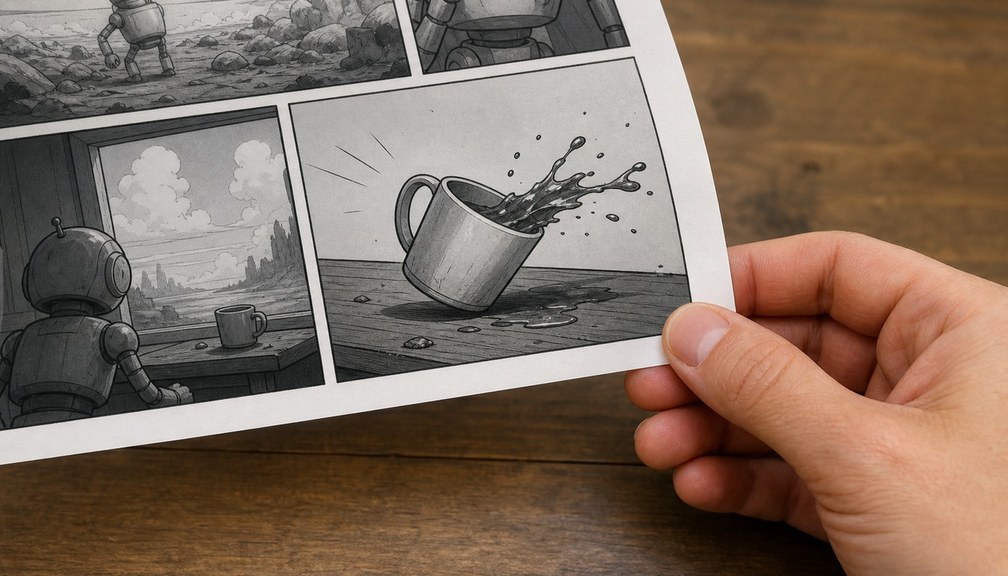
Return to the cup. If one panel places it near the table edge and a later one shows it on the floor with liquid spreading, the supported bridge is simply that the cup fell or was knocked down. Do not name a culprit unless a gesture, expression, line of dialogue or wider story context identifies one. Visual narratives can prompt bridging inferences around omitted events, but useful inference is constrained reconstruction, not an invitation to invent whatever occurred off the page.
The gutter is the visible space between panels; it does not contain one fixed duration or meaning. Adjacent images might indicate movement, elapsed time, a change of place, a new viewpoint, a reaction or a looser thematic relationship. Some panels even touch or overlap, leaving little obvious gutter. Ask what changed, what remained stable and what minimum connection the sequence requires. That method works more reliably than assigning every gap the same kind of missing action.
Read for clarity first; let the page teach you its grammar.
How do balloons, captions and sound effects guide the reading?
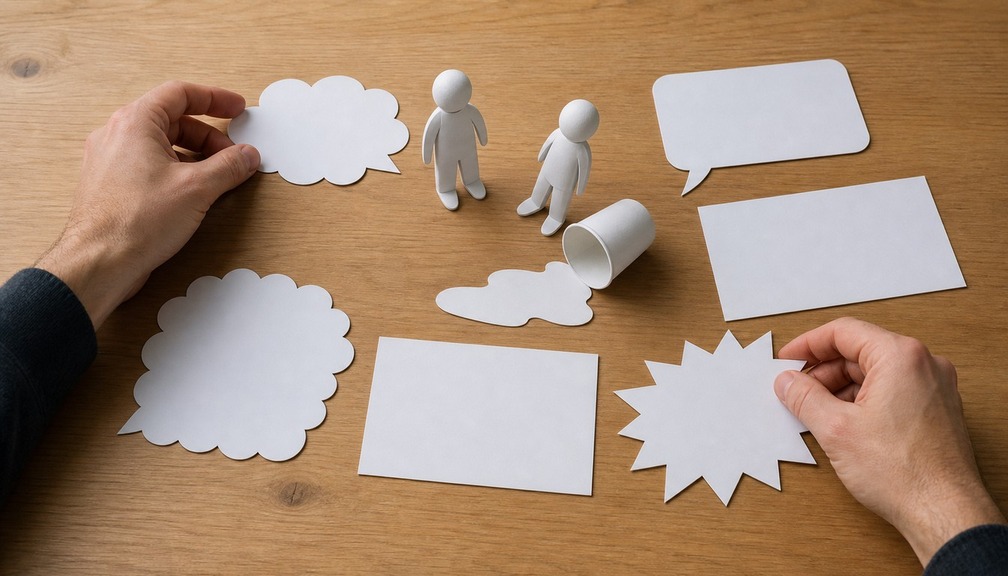
Follow each text form to its likely source, then test that connection against the scene. A balloon tail commonly points towards a speaker; a trail of smaller bubbles may associate private thought with a character; a caption may address the reader without belonging to anyone visible. Free-standing sound lettering can make the cup’s impact part of the picture. Faces, gestures, turn-taking and the page’s reading direction should confirm whichever interpretation the shape first suggests.
Lettering has expressive weight as well as literal content. Size, boldness, border, spacing and position can suggest emphasis, volume, whispering, distress, transmission or the texture of a noise. These are traditions, not guarantees: similar shapes can perform different jobs, and the same function can appear in different containers. Read the words and pictures as interacting channels. An image may locate, qualify, extend or contradict a sentence rather than merely illustrating it.
Common lettering forms and the evidence that should confirm them
Text form
Visible cue
Likely function
What context must confirm
Speech
A balloon, often with a tail
Words spoken within the scene
The tail, speaker’s gesture and conversational turn
Thought
A cloudlike form or a trail towards a figure
Private language associated with a character
Access limited to the thinker and the work’s established style
Narration or internal caption
A box or another detached text container
Reader-facing narration, time, place or internal voice
Voice, tense, viewpoint and repetition elsewhere
Off-panel or transmitted voice
A tail leaving the frame or a specially treated border
Speech from outside the panel or through a device
The scene, response and later identification of the source
Sound effect
Free-standing or strongly stylised lettering
A noise belonging to an action or environment
Its position, scale and relationship to the depicted event
How does the page control emphasis and felt pace?
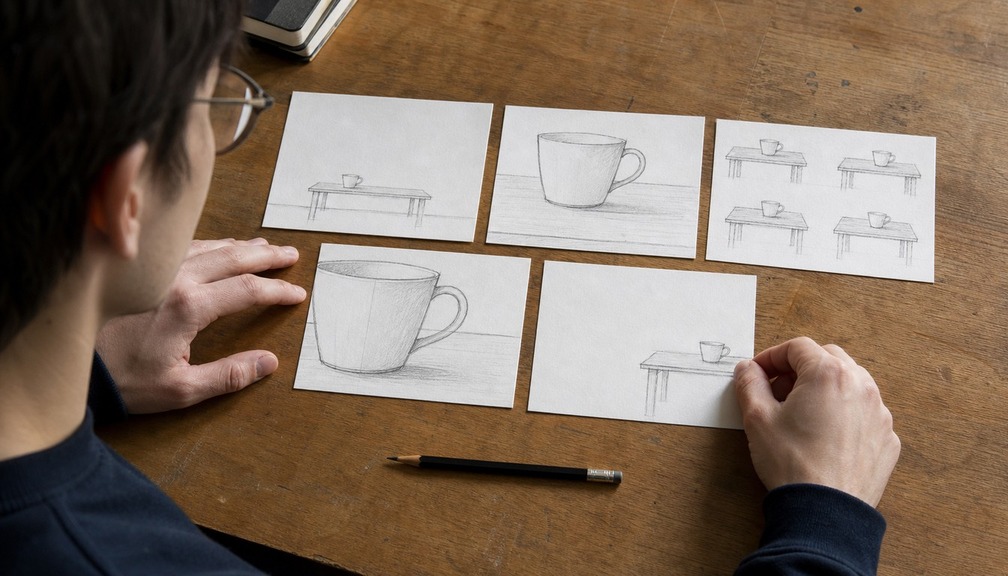
The page controls emphasis by selecting what each frame includes and arranging those selections into a composition. A wide view of the table establishes people, objects and distance; a closer view directs attention to the cup near the edge; an extreme detail may temporarily exclude everything else. The event need not change for its emphasis to change. Shifts in framing alter what receives attention and what information the reader must carry between panels.
Within each image, follow gaze, gesture, foreground and background placement. Then look for relationships across the page: the curve of the cup repeated in another shape, several characters looking towards the same corner, or a balloon positioned so that reading it leads into the next panel. These routes are not always marked by arrows. Composition can guide the eye through alignment, contrast, repetition and the placement of words among pictures.
Felt pace emerges from several cues working together: panel count, framing changes, repetition, silence, scale, visual density, language and story content. Repeating the spreading liquid may hold attention on the aftermath, but it does not specify an exact number of seconds. Nor does a large panel automatically last longer than a small one. Corpus research records systematic use of bleeds, whole-row panels, staggering, separation and overlap; none carries one automatic meaning outside its page.
What makes a page turn feel like a reveal?
A printed page turn creates a reveal when the current page raises a question and the next image remains physically concealed. End the cup sequence with the cup tipping over the edge, and the reader cannot see the fallen cup or the characters’ reactions until turning the sheet. The hand’s action becomes part of the delay. Concealment makes suspense possible, although it cannot dictate precisely how surprised, worried or amused a reader will feel.
The final visible panel might present an approach, threat, interrupted movement or reaction whose cause lies beyond the edge. If you sense such a setup, pause long enough to register the question before advancing; there is no need to calculate a dramatic interval. Equally, not every final panel is a cliffhanger. Sometimes it closes a rhythm or prepares a change of scene, and the next page answers through contrast rather than a startling event.
Format changes the mechanism. A two-page spread may reveal both sides together, making the seam part of one composition rather than a dependable barrier. Guided view can reveal one panel at a time, a swipe can replace one screen with another, and vertical scrolling can keep an image below the visible area. In each case, ask what information is withheld and when it becomes visible instead of assuming that every reveal behaves like a printed page turn.
When should you look back at the page?
Look back whenever a later panel clarifies the route, speaker, action or significance of an earlier image. On the first pass, establish direction, identify the source of each piece of language or sound, and follow the visible changes. On a short second pass, confirm uncertain speakers and compare the evidence before and after the cup falls. Returning is especially useful when a reaction reveals that you misread a gesture or overlooked an off-panel voice.
Finish with one whole-page glance. Notice repeated cup shapes, character gazes, background continuity, silent areas, framing changes and the position of the final beat. Comics comprehension brings sequence, page layout and framed attention together, so this wider view can reveal relationships that were hard to see panel by panel. Eye-tracking research records frequent returns to earlier panels without establishing one motive for every return. Backward movement is compatible with reading the form, not evidence that you have failed.
Use the vocabulary only when it helps. Panels select attention, gutters separate panels, lettering connects language or sound to the scene, and page edges can delay visibility. Those ideas should make the reading experience calmer, not turn it into an examination. Follow clarity first, revise an interpretation when the page supplies better evidence, and allow the grammar of each comic to become familiar through attentive reading.
Questions about reading comic pages
How do you know which comic panel to read first?
Check any direction note supplied by the edition, then scan the page’s rows, columns, gaps, overlaps and dominant panels. For a conventional left-to-right page, the upper-left area is a useful starting point; reverse that expectation for a right-to-left edition. Let clear layout and story relationships resolve exceptions.
What are gutters in comics?
Gutters are the visible spaces between panels. Their width or presence does not assign one fixed duration or meaning to the transition. Compare the adjacent images and story context to decide whether they imply action, elapsed time, a new place, a changed viewpoint or another relationship.
How do you tell which speech balloon comes first?
Begin with the page’s intended reading direction and compare the balloons’ relative positions. Trace tails towards likely speakers, then check turn-taking, facial reactions and conversational sense. If those cues conflict, continue briefly and return once a later line clarifies the exchange.
How do comics tell stories without showing every action?
Panels select particular states rather than depicting every movement. If a cup is shown near a table edge and later on the floor, readers can infer the smallest bridge supported by those images: it fell or was knocked down. A culprit requires additional evidence from the pictures or story.
Why do comic page turns create suspense?
A printed page can pose a question while physically concealing the answering image, so turning the sheet becomes part of the reveal. Spreads, swipes, guided view and vertical scrolling control visibility differently. The common principle is delayed access to information, not one universal page-turn effect.
References & Sources
This article was researched using the following sources:
We write the reading guides we wanted and could not find. Our recommendations lean on reputable sources and bibliographic records, and we say plainly when something is a matter of taste. AI assists with research and drafting, and every guide is checked against its sources before it goes out.
Use six practical checks to match a child with books that suit their interests, reading demands, emotional readiness, preferred format and reading mode.
Compare six mystery and crime-fiction routes by tone, intensity, investigative method and driving question, then choose a low-commitment place to start.