On your first comic page, do five things: check the edition's reading direction, scan how the panels are grouped, follow the balloons to their likely speakers, connect each panel to the next using the visible evidence, and glance back over the whole page. That sequence gives you a route before you worry about terminology. You do not need to absorb every background detail immediately, and you can revise your first reading when a later image clarifies an earlier one. Comics reward movement in both directions.
The reading loop
Check the edition's intended direction before treating any page path as the default.
Use adjacent panels and story context to infer only the bridge the evidence supports.
Read balloons, captions, sound effects, and images together, then test each convention against the work itself.
Treat scale, density, repetition, silence, framing, and content as interacting cues to pace.
Looking back and scanning the full page are normal parts of reading comics.
Where should your eyes go first?
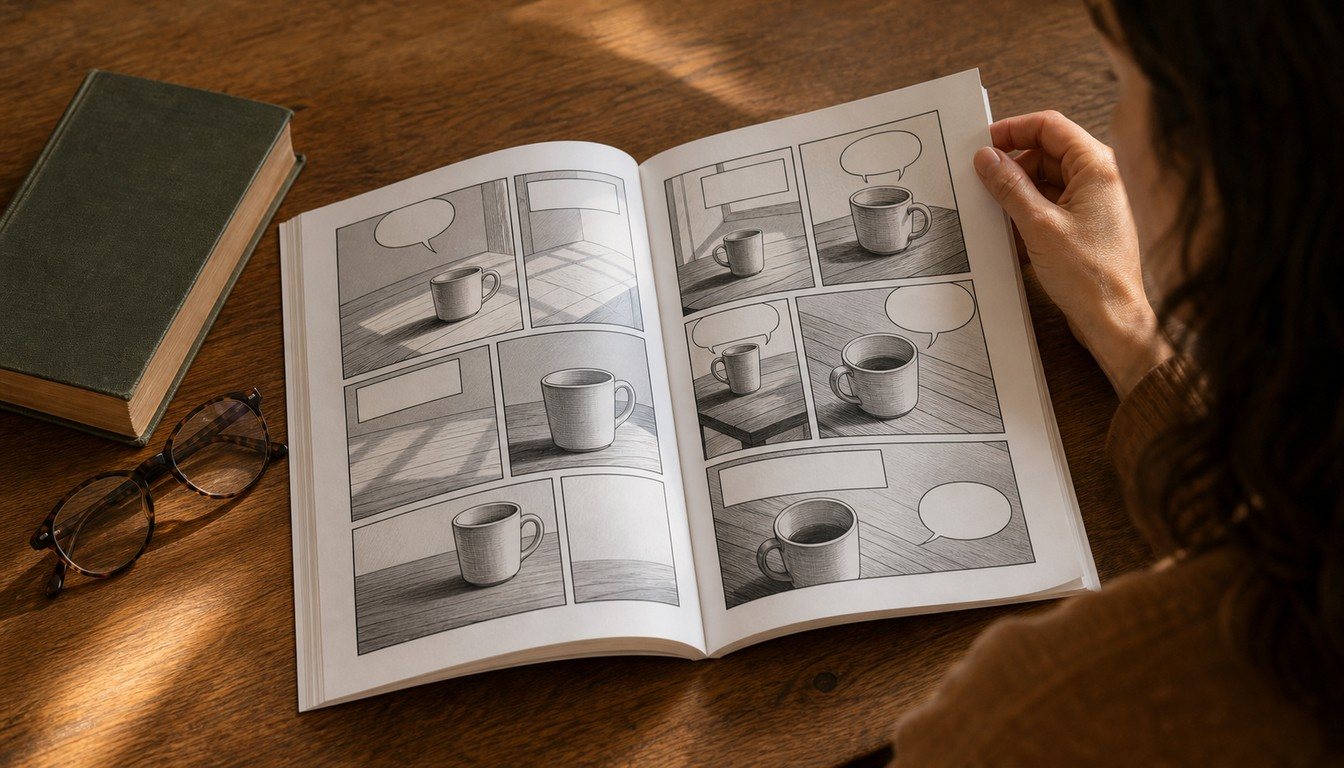
Your eyes should first go where the edition's direction and the page's largest groupings lead them. An English-language edition commonly starts at the upper left and moves across a row before dropping down; many manga editions retain a right-to-left route. Check for a printed direction note before using either convention. Then scan borders, rows, columns, gaps, overlaps, and any panel that dominates the page. This preview reveals the page's broad architecture without forcing you to interpret the story yet.
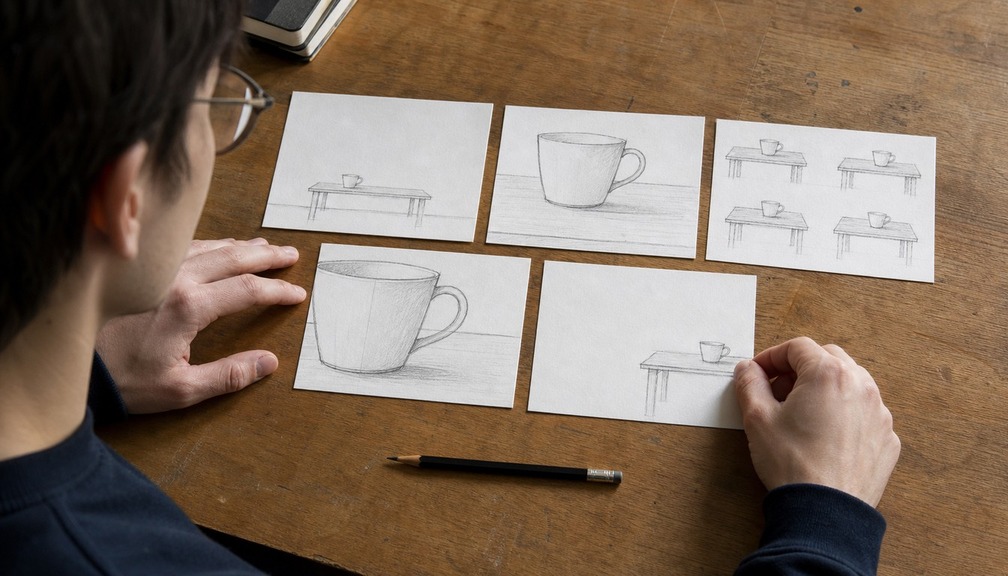
Find the wide panel showing two people, a table, and a cup near the edge.
Move to the closer view of an arm reaching past the cup.
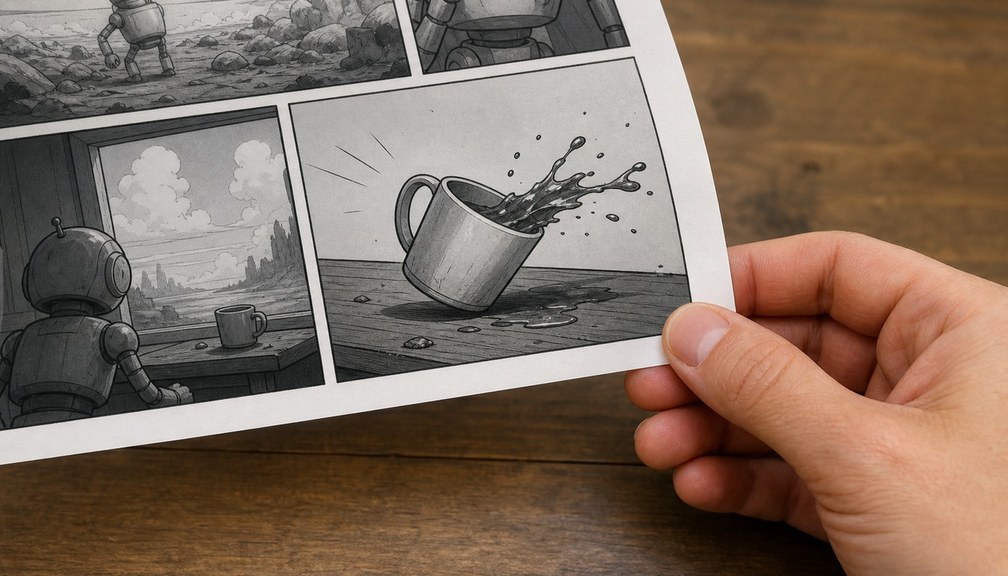
Find the panel in which the cup is now on the floor and liquid is spreading.
Finish with the figure reaching for a towel, then check that the visible changes make sense in that order.
Within a panel group, balloon height, tail direction, gestures, and conversational turn-taking can help settle an uncertain route. Those clues do not override a clear edition note or an obvious visual connection. Research on page navigation supports an across-and-down path as a useful prototype for conventional left-to-right layouts, not an iron rule: observed routes varied, and readers frequently returned to earlier panels. If the towel appears before the spill in your first pass, simply look back and try the alternative path.
What happens between one panel and the next?
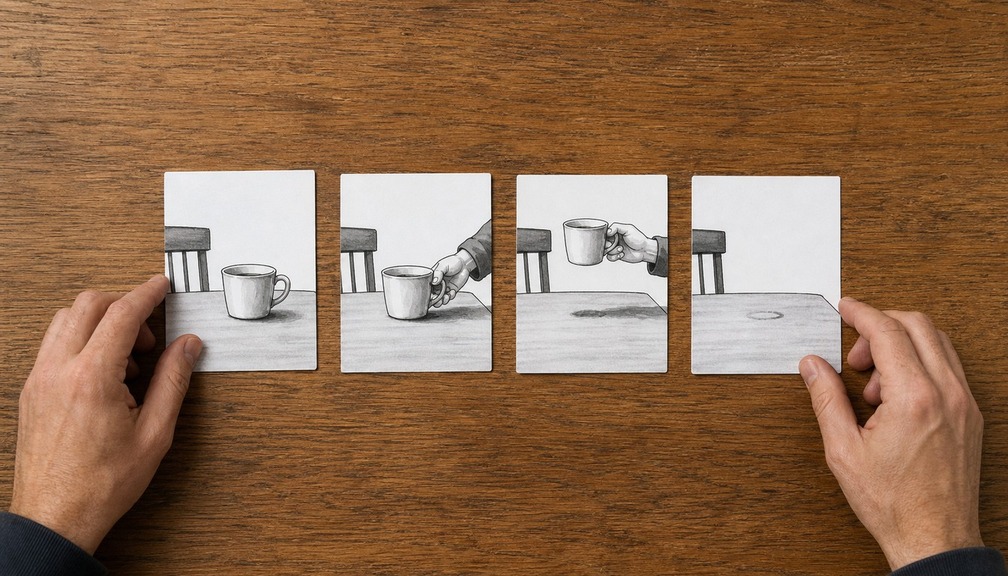
Between panels, you infer the smallest change needed to connect the visible states. Each panel is a frame of attention: it may establish a room, isolate a person, emphasize an object, show movement, or present a result. The next panel need not represent the very next objective instant. Instead, ask what changed and what evidence explains that change. A sequence may suggest a setup, an initiating action, a culmination, and a reaction, but it can omit, repeat, combine, or stretch any of those functions.
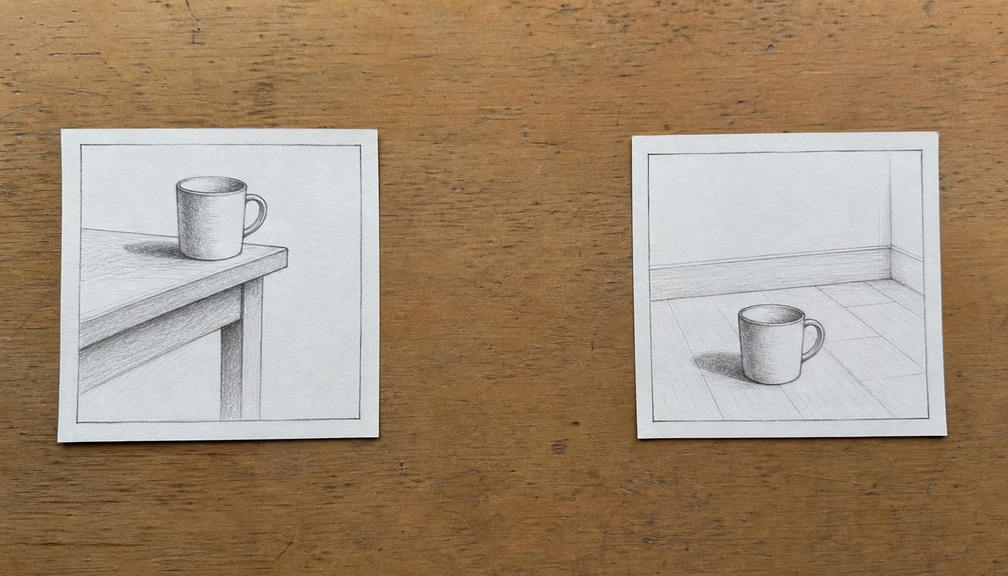
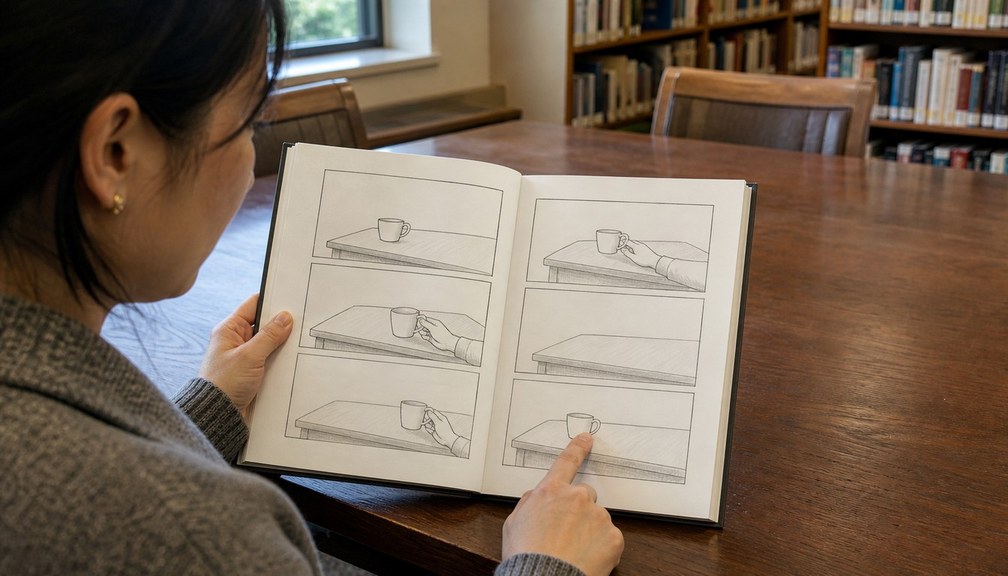
In the practice sequence, one image places the cup near the table edge and a later image shows it on the floor with liquid spreading. The secure bridge is that the cup fell or was knocked down. The panels do not yet prove who caused it, whether it was deliberate, or exactly how long the fall took. Hold those questions open until a gesture, caption, reaction, or later scene supplies more evidence. This restraint keeps your inference connected to the story instead of turning the gap into an invitation to invent.
A gutter is the visible space between panels, not a container with one fixed duration.
Adjacent images may imply motion, elapsed time, a changed viewpoint, a new location, or a conceptual relationship.
Some panels touch or overlap, so the interpretive relationship can exist even when little physical gutter is visible.
Read for clarity first; let the page teach you its grammar.
How do balloons, captions, and sound effects guide the reading?
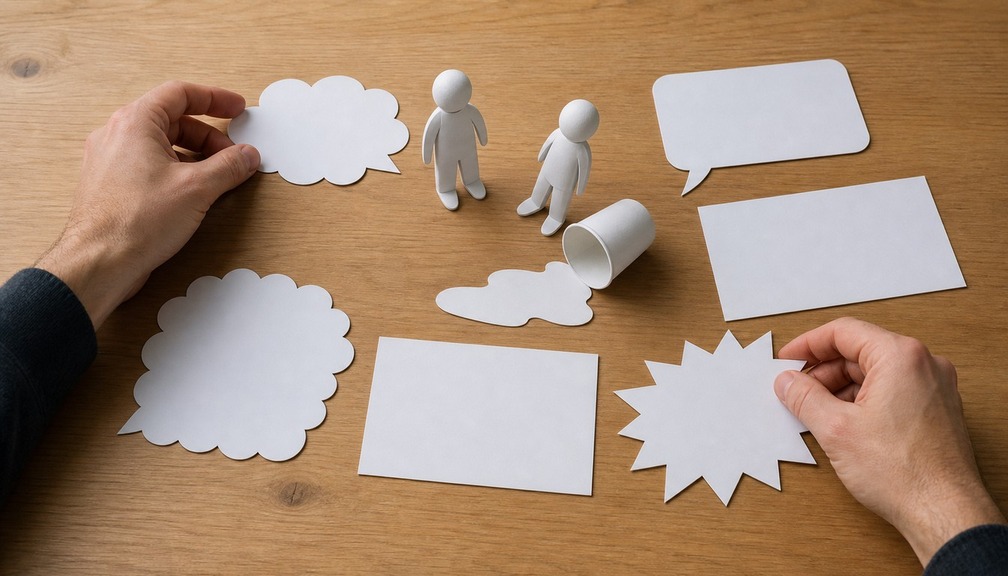
Balloons, captions, and sound effects guide you by connecting language or sound to a speaker, thinker, narrator, device, place, or event. First identify the container or free-standing letters. Trace any tail or trail toward its likely source, then test that reading against faces, gestures, turn-taking, and the scene. When several balloons share a panel, begin with the page's established direction and relative placement, but let conversational sense expose a mistaken order. A reply that seems to precede its question is a good reason to reconsider the route.
Common lettering cues and the evidence that should confirm them
Text form
Visible cue
Likely function
What context must confirm
Speech
A balloon with a tail toward a figure
Words spoken within the scene
Tail direction, mouth or gesture, and conversational turn
Thought
A cloudlike form or trail toward a figure
Private language unavailable to other characters
The work's established style and the figure's perspective
Narration or internal caption
A box or detached text container
Reader-facing narration, time, place, or internal language
Voice, tense, scene knowledge, and repeated caption design
Off-panel or transmitted voice
A tailless, edged, or otherwise marked form
Speech from outside the frame or through a device
Reactions, scene geography, and nearby visual equipment
Sound effect
Free-standing letters integrated with the image
An environmental or action sound
Placement, scale, shape, and the depicted source
These are working cues, not a universal code. Border shape, letter size, weight, spacing, and placement may suggest loudness, whispering, distress, transmission, or the texture of a sound, yet another book may use the same form differently. In the cup scene, a balloon can identify which seated figure speaks, a caption can frame the moment for the reader, and impact lettering can make the fall visible as sound. Read words and pictures together because either channel may locate, qualify, extend, or complicate the other.
How does the page control emphasis and felt pace?
The page controls emphasis and felt pace by deciding what each frame selects, how panels relate, and how much attention the content invites. A wide view of the table establishes people, objects, and space. A close view of the cup makes its position newly important. Repeating the spreading liquid can hold attention on the result, while a dense run of reactions can divide that result into several beats. None of those choices converts into an exact number of seconds; pace emerges from their combination and from your attention.
Follow character gazes and gestures to see where attention moves inside a frame.
Compare foreground and background details for changes that the main action may not announce.
Notice repeated shapes, colours, or viewing angles that echo across separated panels.
Watch where balloons and captions sit, since reading words also moves your eyes through the composition.
After reading the sequence, soften your focus and inspect the page as one design. Compare crowded and open areas, large and small frames, silence and dialogue, repetition and abrupt change. A bleed, inset, overlap, irregular gap, or dominant image may alter grouping or emphasis, but none carries one automatic instruction. Studies of comics layouts document systematic variety in these arrangements across selected traditions. The useful question is therefore not what a device always means, but what relationship it creates on this particular page.
What makes a page turn feel like a reveal?
A page turn feels like a reveal when the current page creates a question and the next image remains physically hidden until you turn. End the practice page with the cup beginning to tip: the unstable position promises a consequence, but the paper edge prevents you from seeing it. Put the fallen cup and the characters' reactions on the next page, and your hand becomes part of the transition from setup to answer. The concealment delays information without guaranteeing that every reader will feel the same degree of surprise.
The mechanism changes with the format. A two-page spread may expose both pages together, turning the seam and the open book into one composition rather than a dependable hiding place. On a screen, a swipe can replace the turn, guided view can reveal one frame at a time, and vertical scrolling can keep an image below the visible area. In each case, ask what information is withheld and what action brings it into view. Pause when a final panel feels like a setup, but do not assume every page ending is a cliffhanger.
When should you look back at the page?
Look back whenever a later panel clarifies the route, speaker, action, or emphasis, and once more after finishing the page. The first pass is for continuity: establish direction, connect language to its likely source, and follow the visible changes. The second pass is for relationships that were harder to notice while you were advancing. Eye-tracking research has observed readers returning to earlier panels, although it cannot tell us that every return serves the same purpose. Backward movement belongs within reading, not outside it.
Confirm any speaker or panel order that felt uncertain on the first pass.
Compare the cup before and after the fall, separating visible evidence from your initial assumptions.
Trace repeated shapes, character gazes, background continuity, silence, and changes in framing.
Finish with one whole-page glance and notice whether the final beat prepares a turn, spread, swipe, or scroll.
This two-pass loop keeps close reading manageable. You are not required to catalogue every line or decode every layout device before continuing. Follow clarity first, return when new context changes what you understood, and let recurring conventions become familiar through use. With practice, panels, gutters, lettering, composition, and reveals stop feeling like separate technical lessons. They become parts of one reading rhythm: move forward, make a careful connection, look back when needed, and see how the page holds together.
Frequently asked questions
How do you know which comic panel to read first?
Check the edition's direction note, then scan the page's rows, columns, gaps, overlaps, and dominant panels. For a conventional English-language page, the upper left is a useful starting point; many manga editions reverse that route. Let clear visual connections and story context resolve exceptions.
What are gutters in comics?
Gutters are the visible spaces between panels. Their size does not assign a fixed duration or meaning to the transition. Compare the adjacent images and context to determine whether the relationship involves movement, elapsed time, a new place, a changed viewpoint, or something else.
How do you tell which speech balloon comes first?
Start with the page's reading direction and the balloons' relative placement. Then check tails, speakers' gestures, turn-taking, and conversational sense. If a response appears to come before the statement it answers, reconsider the order because creators can vary conventional placement.
How do comics tell stories without showing every action?
Panels select particular moments and details, allowing readers to connect the visible states. A cup near a table edge followed by the cup on the floor supports the missing fall, even if the impact is not shown. Further conclusions need further evidence from the images or story.
Why do comic page turns create suspense?
A printed page can establish a question while physically hiding the next image until the turn. That delayed access makes the reader's action part of the reveal. Spreads, swipes, guided views, and vertical scrolling use different boundaries, but each can control when new information enters view.
References & Sources
This article was researched using the following sources:
We write the reading guides we wanted and could not find. Our recommendations lean on reputable sources and bibliographic records, and we say plainly when something is a matter of taste. AI assists with research and drafting, and every guide is checked against its sources before it goes out.