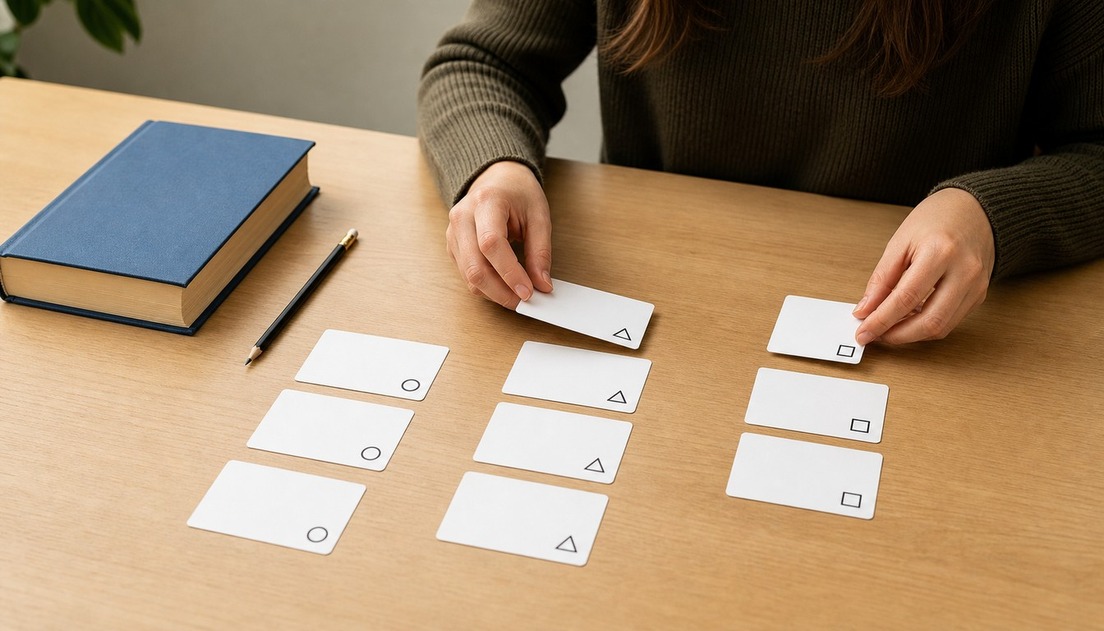
Build two versions of the same reading routine. Choose a recurring event or clock time, keep one current book ready where that cue occurs, and define a normal session that suits your actual attention. For compressed weeks, prepare a deliberately smaller fallback at the same cue when a safe opening remains. If work, care, travel, fatigue or another genuine constraint removes that opening, move or suspend the cue. A miss creates no catch-up debt in this design; it gives you information for the next adjustment.
The routine at a glance
A resilient reading routine has a normal version and, when practical, a smaller busy-week version anchored to the same workable cue.
Choose a recurring event or clock time that leaves a real opening; neither cue type is universally superior.
Set sessions from available attention and natural stopping points, not a universal daily page target.
A missed session creates no catch-up debt in this design and can prompt questions about capability, opportunity or a competing default.
Keep what recurs, revise what repeatedly fails and treat every review interval as flexible rather than a habit deadline.
What is a resilient reading routine meant to measure?
Measure a resilient routine by whether reading can begin when its intended cue returns, including during different kinds of weeks. Identical daily output is not required. A public streak, annual book total or fixed page quota may track something else, but none reveals whether the routine still offers a workable start after a late shift, a long commute, a care-heavy day or an unusually tired evening.
Start with a light observation of one reasonably representative week. This is an editorial exercise, not a validated assessment or an invitation to monitor every spare minute. Its purpose is to compare imagined availability with the moments that actually recur. A week dominated by an exceptional crisis will not tell you much about ordinary patterns, although it may show where the routine needs permission to pause.
Recurring openings: events or times after which reading could realistically begin.
Available attention: whether you could follow the current book at that moment.
Book access: whether the chosen format was ready without extra searching or setup.
Blocked starts: what happened instead, described without turning it into a character judgement.
Treat compressed leisure, necessary sleep, care responsibilities, required work, travel disruption and tasks demanding full attention as possible opportunity constraints. They are not evidence of weak commitment. The useful question is whether an opening genuinely existed. If it did not, record that plainly. If it did but reading repeatedly failed to start, you have identified a cue, access problem or competing default worth examining later.
Which cue will reliably bring your book within reach?
Choose the event or clock cue that most reliably recurs on your intended reading days and normally leaves a safe, usable opening. An event cue might be finishing lunch or settling onto the train; a time cue might be 20:30 on selected evenings. Neither type is automatically better. Test the cue against your real week, especially if rosters, school pick-ups or commuting patterns change.
Evidence for keeping both options comes from an 84-day randomised trial involving everyday nutrition behaviours, not reading. Routine-event and specific-time cue groups both increased plan enactment and automaticity, with no group-level difference between them. That result does not prove every reading cue works equally well. It supports choosing by recurrence and then paying attention to whether you actually enact the plan when the cue arrives.
Turn the choice into a precise if-then start plan: If I finish lunch at work, then I will open the novel in my bag at the break-room table. Implementation intentions link a recognisable situation to a specified response, helping an existing intention meet a usable opportunity. The plan cannot manufacture time, attention or interest, so name a cue, response and location that already make practical sense.
Pick one cue that is easy to recognise rather than several vague reminders.
Name the exact place where the book will be opened.
Stage one current print book, e-reader or deliberately chosen audio edition at that point.
Use another format only when it addresses a specific access or attention constraint.
Book placement is preparation, not a promise. Behaviour-change taxonomies distinguish prompts, added objects and changes to the physical environment, but classification alone does not show that a visible paperback will defeat a phone, conversation or urgent task. Aim for fewer avoidable steps: download the edition beforehand, charge the e-reader, pack the book, or leave it on the side table where the cue occurs.
How should normal and busy-week reading sessions differ?
Make the normal session large enough to feel worthwhile but small enough to fit your observed attention, then define a clearly smaller busy-week fallback. Keep the same cue when that remains practical. This base-and-fallback design is a conservative synthesis of general cue, planning and context research; no cited study has tested this exact two-level routine for reading, so it should be treated as a design to trial rather than a guaranteed method.
Define the normal session by something you can recognise while reading: elapsed time, one scene, one essay section or another natural stopping point. Let the density and structure of the current book matter. Ten pages of a demanding history and ten pages of a fast novel may require different attention. The evidence supplied here does not validate a universal duration, page count, chapter target or requirement to read every day.
The fallback is simply a brief, honest start that remains feasible when the week tightens. It might end at an earlier natural stopping point than the normal session, but it needs no universal minimum. Never use it by borrowing from necessary sleep, care, recovery, employment duties, driving or another safety-critical activity. When no safe opening exists, skip, move or suspend the cue, and resume without adding a compensatory session.
Cue: the recurring event or clock time that signals a possible start.
Location: the specific place where you expect to read.
Normal session: the time span or natural stopping point that fits an ordinary day.
Busy-week fallback: the smaller response you can genuinely perform when an opening remains.
Book access: the title and format staged at the point of use.
Restart plan: return at the next safe cue, or choose a replacement cue if the old one has disappeared.
A durable reading routine does not demand the same output from every week; it gives reading a workable way to begin in more than one kind of week.
What actually blocked a missed reading start?
Use capability, opportunity and motivation as overlapping questions about a missed start, not as scores or moral labels. The COM-B framework describes behaviour as arising through interaction among those three elements. It was developed as a general behaviour and intervention-design framework, not as a validated questionnaire for readers. Here, it provides tentative explanations that you can compare with what happened, rather than a definitive diagnosis.
Capability asks whether you could follow this book in this format at that moment. Opportunity asks whether the schedule and surroundings left a safe opening. Motivation includes deliberate choices as well as automatic processes, so it can cover a competing default or a book that no longer appeals. More than one explanation may apply: low attention can coincide with a disrupted setting and an easier alternative already under your hand.
Three non-moralising lenses for reviewing a missed start
Lens
Question to ask
Constraint to accommodate
Possible response
Capability
Could I physically and mentally follow this book in this format?
Acute fatigue, inaccessible print, book density beyond the attention available, or a setting unsuitable for listening or visual reading.
Shorten the fallback, move the normal session to a higher-attention opening, or consider a more accessible format.
Opportunity
Did the schedule and environment leave a safe, usable opening?
Care demands, an exceptional deadline, travel disruption, necessary sleep, unavailable privacy, or a task requiring full attention.
Use the fallback only if an opening exists; otherwise move or suspend the cue without catch-up debt.
Motivation and competing defaults
Was there an opening, but another action happened automatically or the book held little appeal?
An alternative is not inherently a defect; focus only on a repeated default you personally want to change.
Make the book the first visible option, sharpen the if-then plan, or select a more compelling current read.
The table separates accommodation from redesign. A care demand or unsafe setting calls for accommodation, not a more aggressive reminder. An unreliable cue can be replaced. Avoidable setup can be removed. A feed opened automatically might be a default you choose to change, but leisure alternatives need no moral ranking. This use of COM-B and environmental techniques is an editorial application, not a tested reading intervention or proof of what caused any single miss.
How do you review the routine and restart after disruption?
Review the routine after a representative trial period, keeping what genuinely recurred and changing what repeatedly proved unworkable. Two weeks can be a convenient example, but it is not a habit-formation deadline. Look at starts rather than total output: did the cue appear, was the book available, did the normal session fit, and was the fallback feasible on compressed days?
Research does not justify promising that a reading habit will form on a set date. Time to peak automaticity varied in the cited nutrition trial. In a separate study of self-selected eating, drinking and activity behaviours, one missed opportunity did not materially alter the modelled formation process. That finding neither tells us how many misses are harmless nor creates a reading-recovery rule. The no-debt restart remains a deliberate feature of this article's design.
Keep a cue and setting that appeared reliably across the trial.
Resize the normal session if it repeatedly exceeded the attention available.
Resize or relocate the fallback if it was not genuinely usable during busy days.
Change one repeated source of avoidable friction, then observe whether the revised routine works.
After travel, an exceptional deadline, a care disruption or another interruption, return at the next safe occurrence of the cue. If that cue no longer exists, select a replacement rather than recreating the old week. More stable contexts were associated with stronger automaticity and goal attainment in the cited non-reading datasets, but those population and self-report limits matter. Your review asks only whether this context reliably works for you.
Fill in one six-field routine card and try it across a stretch containing both ordinary and busy days. Keep only what proves workable. If the recurring obstacle is an inaccessible format, ask a librarian or accessibility service about format-specific options. Measure improvement by whether reading has a realistic way to begin across different weeks, not by a streak or a pile of finished books. The routine must remain secondary to sleep, care, recovery, required work and safety.
Reading routine FAQs
How do I build a reading habit when I am busy?
Choose a recurring cue, stage one current read where it occurs and set a normal session that matches your available attention. Add a smaller busy-week fallback only when a safe opening remains. If essential obligations remove the opening, suspend or move the cue without creating catch-up debt.
Do I need to read every day to build a reading routine?
No supplied evidence validates mandatory daily reading, an unbroken streak or a universal frequency. Aim to begin when your chosen cue occurs on your intended reading days. A routine can be consistent without producing identical output every day.
Should I use a time cue or an event cue for reading?
Either can be workable. An 84-day nutrition-behaviour trial found increased plan enactment and automaticity in both cue groups, with no group-level difference, but it did not study reading. Test which cue actually recurs and leaves an opening in your own week.
How long should a realistic reading session be?
There is no supported universal number of minutes or pages. Base the session on observed attention, the density of the book and a recognisable boundary such as elapsed time, a scene or a section. Make the busy-week version deliberately smaller.
What should I do after missing several reading sessions?
Do not build a catch-up pile; that is a feature of this routine design, not a research finding about multiple misses. Review capability, opportunity and motivation as overlapping prompts, accommodate genuine constraints, and change only a cue or friction that repeatedly fails. Return at the next safe cue or choose a replacement.
References & Sources
This article was researched using the following sources:
We write the reading guides we wanted and could not find. Our recommendations lean on reputable sources and bibliographic records, and we say plainly when something is a matter of taste. AI assists with research and drafting, and every guide is checked against its sources before it goes out.
Build a book club that lasts with clear, adjustable agreements for membership, timing, book choices, shared roles, access and a three-discussion review.