Choose the edition that fits the next reading moment, the particular book and the way you intend to use it. Print, ebooks and audiobooks each solve different problems, and none deserves to become a permanent reader identity. Begin with where you will read and how much attention, power, connectivity and carrying capacity you will have. Then inspect the book's layout and navigation, test any access requirements, consider privacy and control, and compare the exact editions available through Australian shops and libraries. That sequence is a practical editorial method, not a scientifically validated ranking system.
The short version
Choose for the next reading moment, not for a permanent reader identity.
Start with print when a stable page, easy visual scanning or device-free reading matters most.
Start with an ebook when carrying capacity, retrieval or adjustable presentation matters, then verify the exact edition and reading system.
Start with an audiobook when the setting leaves enough listening attention and the production suits the book.
Compare actual editions, access features, privacy terms, current prices and library availability before committing.
What should your next reading moment allow?
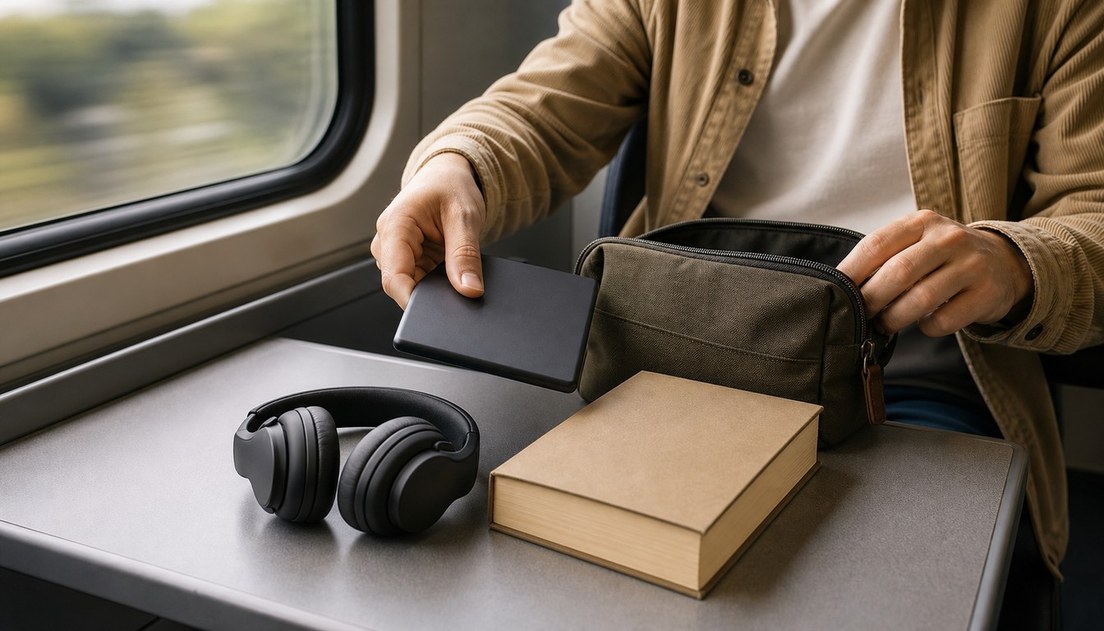
Let the setting establish your initial shortlist. Picture the next session rather than an ideal reading life: a packed train, a quiet evening at home, a lunch break or a trip with limited luggage. Ask whether your eyes and hands are available, how much attention the setting safely permits, and what you are willing to carry or charge. An audiobook belongs only in a situation that leaves enough listening attention; set it aside whenever safety, caregiving, navigation or control of equipment requires your full attention.
For travel, an ebook or downloaded audiobook is a sensible starting point when one device needs to carry several titles. Confirm that the file is downloaded, the battery and storage are adequate, headphones are practical, and access will continue offline for as long as needed. A paperback already on hand avoids charging and data requirements, but weight, print size, lighting and storage still matter. Convenience is therefore a bundle of conditions, not simply the lightest object in your bag.
Seven useful starting points, each subject to an edition-level check
Situation
Likely starting point—not a verdict
What to verify before choosing
Travelling light or carrying several books
Ebook or downloaded audiobook
Battery, storage, offline access, headphones, access duration and whether important visuals survive the edition.
Hands occupied with spare listening attention
Audiobook
Safety, background noise, narrator sample, chapter navigation and whether the activity leaves enough attention.
Quoting, searching, comparing passages or building notes
Searchable ebook or print
Search, index quality, stable references, annotation durability, export and movement between distant passages.
Illustrated, typographically unusual or page-dependent work
Print or a verified fixed-layout digital edition
Sample pages, display size, image quality, colour, facing pages, zoom, text alternatives and accompanying material.
Adjustable text or hands-free access is essential
Accessible ebook, accessible talking book or audio
Accessibility metadata, reflow, text controls, navigation, descriptions, playback controls and assistive-technology compatibility.
Device-free, low-data or locally controlled reading
Print already on hand
Weight, print size, lighting, page handling, storage and any purchase or borrowing record.
Lowest-cost route to one title
Whichever exact edition is affordable or borrowable now
Library holdings and waits, used and new print, digital price, access term, required hardware and continuing access.
How does this book need to be read and revisited?
Choose according to the book's page design and the interactions you will need. Before buying or borrowing, inspect sample pages for maps, illustrations, equations, footnotes, unusual typography and facing-page relationships. EPUB can be reflowable or fixed-layout, so the word ebook does not tell you how a particular page will behave. Reflowable text can adapt to a display and text preferences, while a fixed layout preserves composition; either can be the better fit depending on the work and the screen.
For study, quotation or close comparison, test the exact edition rather than relying on format folklore. Look for full-text search, a usable index, clear chapter navigation, stable references, quick backtracking and annotations that remain available for as long as you need them. Libby's reader, for example, can search for a word or phrase and jump to matches, but that documented feature does not make every ebook searchable. Page numbers in a reflowable edition may also be unsuitable as universal references.
Think about how you want to return to a passage. Marks in an owned print copy stay directly visible, although that approach depends on being willing to write in the book and carry it. Libby documents ebook bookmarks, highlights, notes and export, while its audiobook tools use time positions, passage highlights and attached notes. Those examples show what some systems can do, not what every edition guarantees, so check whether notes persist after a loan and whether you can move them elsewhere.
Which edition works with your body, senses and access setup?
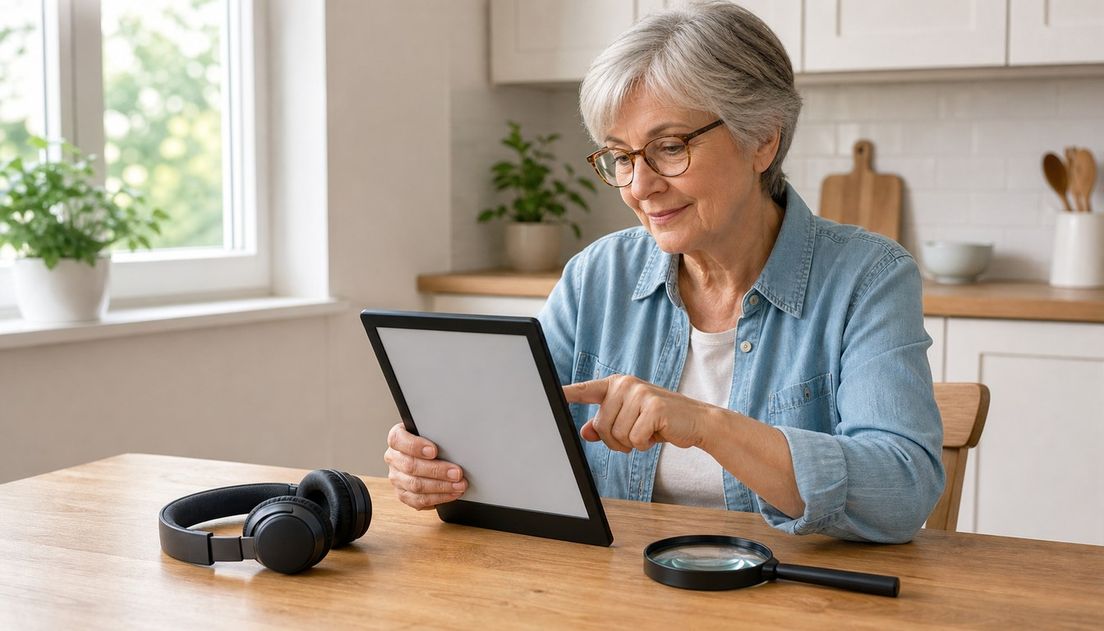
Accessibility belongs to the exact publication, reading system and personal setup, not to the format label alone. Test the combination you will actually use: the book file, app or device, and any assistive technology. Check reflow, text size and spacing, contrast, zoom, screen-reader behaviour, navigation, image descriptions and playback controls as relevant. An EPUB file is not automatically accessible, just as an ordinary commercial audiobook is not automatically equivalent to a specialised accessible talking book.
EPUB accessibility metadata can identify required access modes and included features, giving you useful edition-level information before opening the book. Still, metadata may be missing from a shop or catalogue, and technical conformance cannot promise that a book will suit every reader. Use a sample when available and test essential actions, including finding chapters, changing presentation, moving backwards, locating notes and resuming playback. If an access need is decisive, a librarian or assistive-technology specialist can help investigate the exact edition and system.
Treat narration as part of the audiobook edition. Sample the narrator or cast for pacing, pronunciation, clarity and production, then check chapter navigation and any accompanying maps or illustrations. A voice that suits one reader or novel may distract another, so there is no universally preferable style. Some EPUB publications can synchronise prerecorded narration with text and highlighting through media overlays when the book and reading system both support them, but ordinary ebooks and audiobooks should not be assumed to include that capability.
What privacy and control trade-offs come with the format?
No format is wholly private, but the records and points of exposure differ. Reading an owned print copy offline does not send your progress or annotations to a reading service; buying or borrowing it can still create a transaction record, while its cover, shelf position and handwritten notes may be visible to other people. Digital reading adds a service, account or connected device to the arrangement, so privacy should be assessed at the provider level rather than inferred from the word ebook or audiobook.
For a digital edition, inspect account requirements, offline options, synchronisation behaviour, retained activity, deletion choices and what happens when a loan or subscription ends. Read the applicable privacy statement instead of assuming that every platform works like a familiar one. Libby's privacy statement, for example, says that the service uses IP addresses and may receive text entered into fields such as notes, tag descriptions and library card names. That is a transparent example of one provider's practices, not evidence about every reading service.
A useful review asks what data is collected, why it is needed, how long it is retained, who can access or receive it, what choices the reader has, and how deletion works. The American Library Association's vendor guidelines cover those themes as well as data minimisation and security. Use them as a practical checklist, while remembering that they are United States professional guidance rather than Australian law or proof that a particular provider has passed an independent privacy audit.
Which edition is actually available and affordable now?
Compare the exact editions you can obtain now, because a general price ranking will not answer the decision. Check the current ebook, audiobook and print options for the title, including new and second-hand copies, library loans, access duration, hardware already owned, connectivity and any limits on sharing or resale. A low advertised digital price may be irrelevant if the edition lacks a required map, expires before a trip ends or needs a device you do not already have.
Search your public library catalogue by both format and language. Libraries build their own digital collections, so a title may be missing in a particular format or language; it may also be unavailable for library purchase or never have been published digitally. Absence from one digital service does not rule out a print holding or another local option. If the catalogue is unclear, ask library staff what editions are held, what can be requested and whether an accessible-format service may be relevant.
Allow for waiting as well as price. Libby explains that digital titles can require holds because libraries commonly acquire individual copies that are lent to one reader at a time, with copy numbers influenced partly by demand and budget. The quickest route might therefore be print for one title, an ebook for the next and audio for another. When possible, borrow or sample before committing, particularly when narration, layout, access controls or annotation features will determine whether the edition works.
Changing formats between books—or between sessions in the same book—is a successful adjustment, not inconsistency. A compact ebook may suit the train while print makes a map-heavy chapter easier at home; audio may fit a quiet walk while a searchable edition supports later reference. If a sample cannot settle an essential compatibility question, ask a librarian, accessible-reading service or assistive-technology specialist about the specific publication and reading system. The aim is a workable match, not loyalty to a medium.
The best format is not a reader identity; it is the edition that fits this book in this moment.
Frequently asked questions
Print vs ebook vs audiobook: which is best?
There is no universal winner. Check your next reading moment, the particular book, your access requirements, the privacy and control terms, and the exact editions available now. The best choice is the edition that fits those conditions, and it can change from one book or session to another.
Is an ebook or audiobook better for travel?
Both are useful starting points when you want to carry several titles. For an ebook, check the display, battery, storage and offline file; for audio, also check headphones, narration and whether the setting leaves enough listening attention. A visual or page-dependent book may still make print or a suitable larger display the better choice.
Which book format is best for studying, quoting or taking notes?
Start with print or a searchable ebook, then test the exact edition. Check search, index quality, references, annotation persistence, export and how quickly you can compare distant passages. Audio can support time-position bookmarks or notes in some players, but those interactions differ from scanning marked text.
Are ebooks more accessible than print books?
Not automatically. Suitability depends on the publication, its accessibility metadata, the reading system and the reader's own setup. Test reflow, presentation controls, navigation, screen-reader behaviour and other essential functions together, and seek specialist help if an unresolved compatibility issue is decisive.
Is an audiobook cheaper than an ebook or physical book?
No format is consistently cheapest for every title. Compare current editions, library holdings and holds, access duration, hardware you already own, subscription or borrowing conditions, and whether access continues when the term ends. The least expensive workable option may differ from one book to the next.
References & Sources
This article was researched using the following sources:
We write the reading guides we wanted and could not find. Our recommendations lean on reputable sources and bibliographic records, and we say plainly when something is a matter of taste. AI assists with research and drafting, and every guide is checked against its sources before it goes out.