How to Organize a Home Library for the Way You Find Books
Organize your home library around the clues readers remember, with clear rules for author, genre, subject, series, shared shelves, and oversized books.
Organize a home library around the clue your household actually remembers, not around a system that merely looks orderly. Use author order where people search for known writers, genre where they browse for a kind of story, subject where they begin with a nonfiction question, and a clearly named sequence where chronology matters. Give each zone one primary rule and one tie-break, choose one stable home for ambiguous books, and name any oversized or vulnerable-book location that breaks the main order.
The retrieval-first approach
Organize each shelf zone around the clue household readers usually remember.
Give every zone one primary rule, one tie-break, and one stable decision for ambiguous books.
Alphabetical, genre, subject, chronological, size-based, and hybrid systems solve different problems.
Treat oversized or vulnerable books as named physical exceptions.
Test representative books on one shelf before moving the full collection.
What do readers in your household remember first?
Start with several recent searches from every regular household reader and record the first usable clue each person had. One search might begin with an author's name, while another begins with “a mystery,” “something about local history,” the next volume in a series, or the memory of a very tall book. The exercise is a practical audit, not a validated test, but it reveals which clues your shelves need to serve.
Separate known-item searches from browsing. A reader seeking a specific author needs a predictable route to one item; a reader seeking a kind of story or material about a question needs useful neighbors to compare. Professional bibliographic work likewise distinguishes names, subjects, classification, and shelf location, but a home does not need to reproduce a professional catalog. Borrow the distinction between access clues, then keep the household rules modest.
Author or title: the reader is looking for a known book or writer.
Genre or mood: the reader wants to browse fiction with related conventions or atmosphere.
Subject: the reader starts with a question, field, activity, place, or historical period.
Sequence: the reader remembers series order or another explicitly defined chronology.
Physical format: the reader remembers size, shape, or an exception location.
Mixed clues: different parts of the collection are retrieved in genuinely different ways.
Which shelf system fits each retrieval task?
Match the system to the task instead of searching for one universally best arrangement. Alphabetical-by-author order is useful when the remembered clue is a writer and when users want a rule that requires little interpretation. Decide in advance how edited works, anthologies, multiple authors, pseudonyms, and series will be handled. Inside an author's run, use series order only when that sequence is how the household expects to retrieve the books.
Genre zones suit fiction browsing, while broad subject zones suit nonfiction browsing that begins with a question or field. Use labels household readers understand rather than treating categories as objective. OCLC's Dewey introduction notes that one subject may appear in more than one discipline depending on the aspect being treated. That ambiguity is normal: choose one physical home for a boundary book, then reconsider it only if repeated searches consistently lead elsewhere.
Chronological order works only after you define the chronology. Series reading order, original publication date, an author's publication history, story chronology, and the historical period discussed are different sequences. Size-based order usually solves fit or support rather than intellectual retrieval. A hybrid is appropriate when zones are used differently, but it should remain a collection of simple local rules, such as genre then author for fiction and subject then author for nonfiction.
A useful home-library system does not eliminate ambiguity; it gives ambiguity one predictable place to land.
Choose a shelf system by the retrieval task it serves
System
Best retrieval task
Main weakness
Useful tie-break
Alphabetical by author
Finding a known writer
Scatters related topics
Series order or title
Genre
Browsing fiction
Genres overlap
Author within each zone
Subject
Browsing nonfiction questions
Books cross subjects
Dominant household use
Chronological
Following a defined sequence
Dates answer different questions
Name the sequence explicitly
Size-based
Solving fit or support
Separates related books
Use a named exception area
Hybrid
Serving different local tasks
Too many rules become confusing
One tie-break per zone
How much structure does a growing or shared library need?
Add formality only when observable retrieval problems call for it. If everyone can scan the collection and remember where most books live, broad zones or one alphabetical run may be sufficient. There is no useful universal book-count threshold. When boundaries keep shifting or ambiguous books repeatedly return to different places, stabilize the zone names and tie-breaks before creating more categories. Add visible labels only where a boundary is otherwise difficult to recognize.
Shared shelves need language and return rules that regular users can apply. Agree on everyday zone names, how surnames are treated, where series go, and what happens when someone is unsure. A temporary return shelf or shallow basket can hold books for later reshelving, but it is optional rather than a judgment about carelessness. If books occupy several rooms or exception areas, a lightweight record may note room, bookcase, zone, and outstanding loans.
Zone name: the household term users will recognize.
Retrieval clue: what a reader usually remembers first.
Primary rule: the main grouping or sequence.
Tie-break: the inner order used when several books share the primary clue.
Ambiguous-book decision: the chosen home for a boundary case.
Physical exception: the named location for books that cannot safely fit the normal run.
Return location: the shelf, tray, or other agreed place used when reshelving is uncertain.
When should size or condition override the shelf order?
Let physical needs override the retrieval rule when an upright or closely adjacent placement would leave a book unsupported. The U.S. National Archives advises storing small to medium books in sound condition upright, with roughly similar-size neighbors providing support. An incompletely filled run can use a bookend. Leave enough room to remove and return books without forcing them, rather than packing the shelf so tightly that ordinary handling becomes difficult.
Large, heavy, fragile, distorted, or otherwise unsupported volumes may need flat storage or shelving that supports the whole volume, depending on construction and condition. Keep flat stacks limited, never bridge a horizontal book across the tops of upright volumes, and do not let books project beyond shelf edges. Name the oversized or vulnerable-books area, and add a location note only when household readers repeatedly forget where that exception lives.
Keep ordinary sound volumes upright and supported.
Use neighboring books of roughly similar size or a bookend for support.
Give qualified oversized or vulnerable volumes full-surface support.
Treat the exception location as a local physical rule, not the organizing principle for every shelf.
How can you test the system before moving every book?
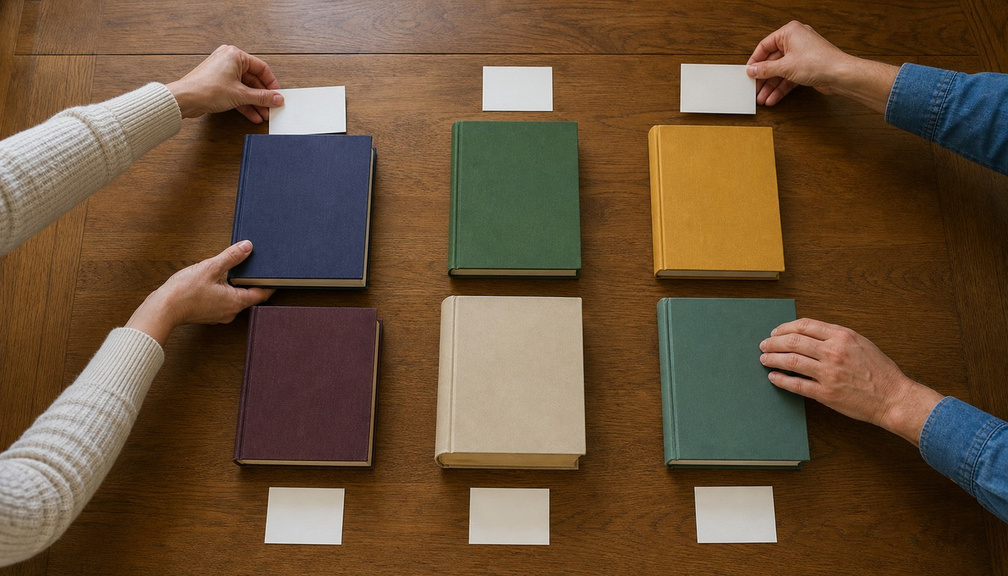
Test one representative shelf before reorganizing the entire collection. Include straightforward books, a cross-genre or cross-subject boundary case, a short series, and an awkward or oversized format. Write the proposed zone rule first so nobody has to infer it during the exercise. Then ask regular users to place, find, and return the sample books using clues from recent real searches, without inventing a speed target.
Choose a sample that includes easy cases, ambiguity, sequence, and a physical exception.
Write the zone name, retrieval clue, primary rule, tie-break, boundary decision, exception, and return point.
Have regular users place, find, and return books using the clues they naturally remember.
Revise vocabulary, boundaries, or tie-breaks when users make different reasonable choices.
Treat disagreement as information about the rule, not as proof that someone was careless. If two users choose different plausible locations, clarify the zone label or decide which clue should control that book. Move the full collection only when household readers can explain and apply the sample rules. This exercise can expose friction before a large move, but it is an editorial check rather than proof that the arrangement will remain effective as the collection changes.
The finished system should use the smallest set of rules your household can remember. Keep the physical sequence stable, revise only failures that actually appear, and let exception notes remain optional. A shelf can support several ways of thinking about a book, but the book itself still occupies one place. When that place follows an understood retrieval clue, returning a volume becomes part of the system instead of a fresh classification decision.
Home library organization FAQ
What is the best way to organize a home library?
There is no universal best arrangement. Choose each zone's rule from the clue household readers usually remember, whether that is author, genre, subject, sequence, or physical format. Give the zone one tie-break and every ambiguous book one stable home.
Should books be organized by genre or author?
Use author order when readers usually seek a known writer. Use genre zones when they browse fiction for a kind of story, then consider author order inside each genre. Choose one declared genre home for cross-genre books.
How should nonfiction books be organized at home?
Use broad, household-facing subject zones when readers begin with a question or field. Apply one predictable inner sort, such as author or title, and avoid categories so narrow that their boundaries constantly move. Give cross-subject works one chosen home.
Where should oversized books go in a home library?
Large or otherwise unsupported volumes may need a named flat or fully supported exception area. Keep flat stacks limited and support each volume's whole surface. Add a location note only if the exception is repeatedly forgotten.
Do I need to catalog my home library?
A catalog is optional. A lightweight location record becomes more useful when books are spread across rooms, loans are hard to remember, or physical exceptions repeatedly disappear from memory. Record only the details that solve those problems.
References & Sources
This article was researched using the following sources:
We write the reading guides we wanted and could not find. Our recommendations lean on reputable sources and bibliographic records, and we say plainly when something is a matter of taste. AI assists with research and drafting, and every guide is checked against its sources before it goes out.
Choose print, ebook, audiobook, or a flexible mix by weighing the moment, the book, accessibility, privacy, cost, and exact editions available right now.
Build a flexible reading routine with a reliable cue, realistic normal session, smaller busy-week fallback, and a simple way to learn from missed starts.
Learn to separate what you loved about a book, rank the qualities that matter now, and turn them into a precise brief for choosing your next great read.