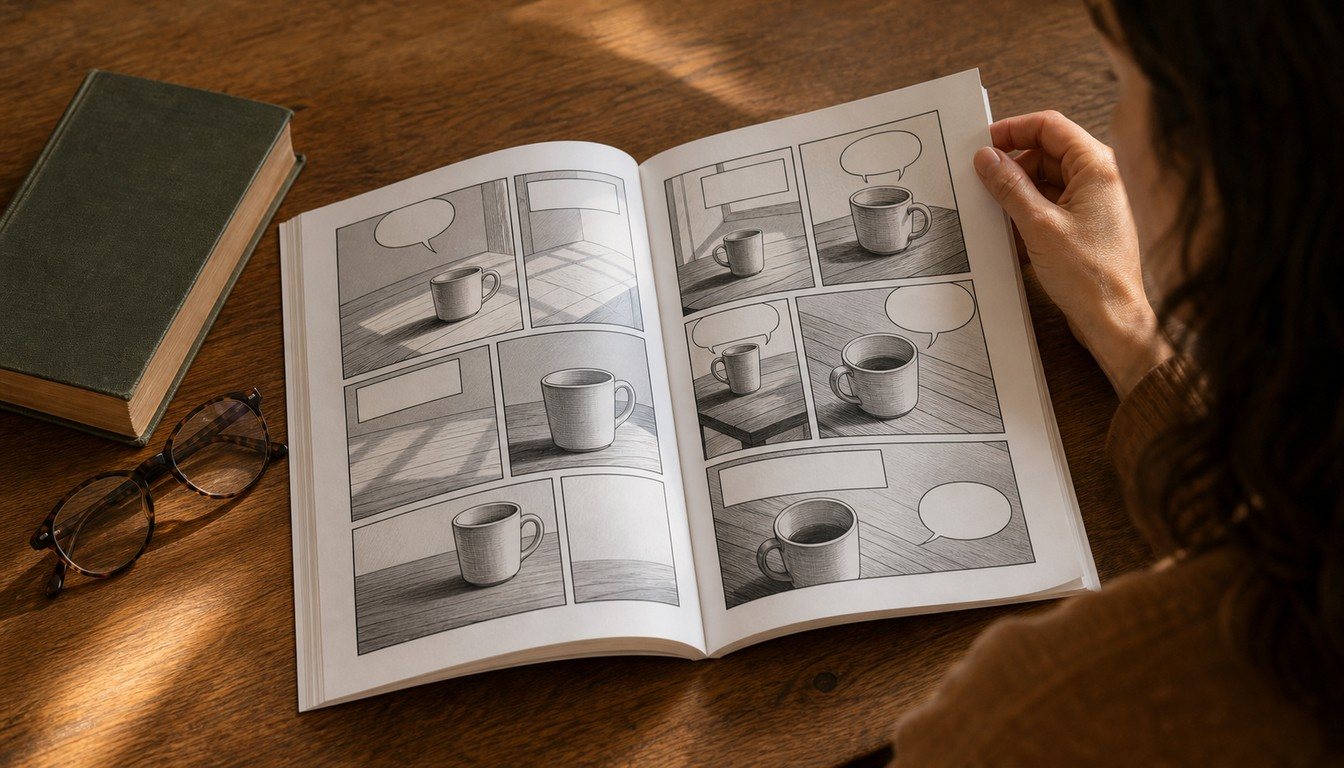
Start a new comic page by doing five things in order: check the edition’s intended reading direction, scan the borders and panel groupings, follow balloons to likely speakers, connect each panel to the next using visible evidence and story context, then glance back over the whole page. The first pass is for orientation, not exhaustive inspection. If the route becomes uncertain, pause and test neighboring panels against conversation, gaze, and continuity. A later panel may revise your first understanding, and looking back is a normal reading move, not a failure. Comics ask you to coordinate sequence, layout, language, and framed images; no single cue has to carry all that work. Once the basic route and voices are clear, the details become easier to notice without turning the page into a puzzle you must solve perfectly.
The reading loop at a glance
Check the edition’s intended direction before treating any page path as the default.
Infer the smallest bridge supported by adjacent panels and the surrounding story.
Read balloons, captions, sound effects, and images together, then verify each cue in context.
Treat scale, density, repetition, silence, framing, and content as combined pacing cues.
Look back and scan the whole page whenever later information changes your understanding.
Where should your eyes go first?
Your eyes should go first to any reading-direction note supplied by the edition, followed by a quick scan of the page’s largest groupings. On a conventional left-to-right page, the upper-left panel and a movement across the top before descending offer a useful starting route. A right-to-left edition calls for the corresponding reversal. Before committing, notice rows, columns, borders, gaps, overlaps, inset panels, and any image that dominates the page. Research on a 60-comic corpus found systematic differences among selected European, Asian, American mainstream, and American independent works, so one familiar route should never become a universal rule. The edition and the particular page remain your best guides.
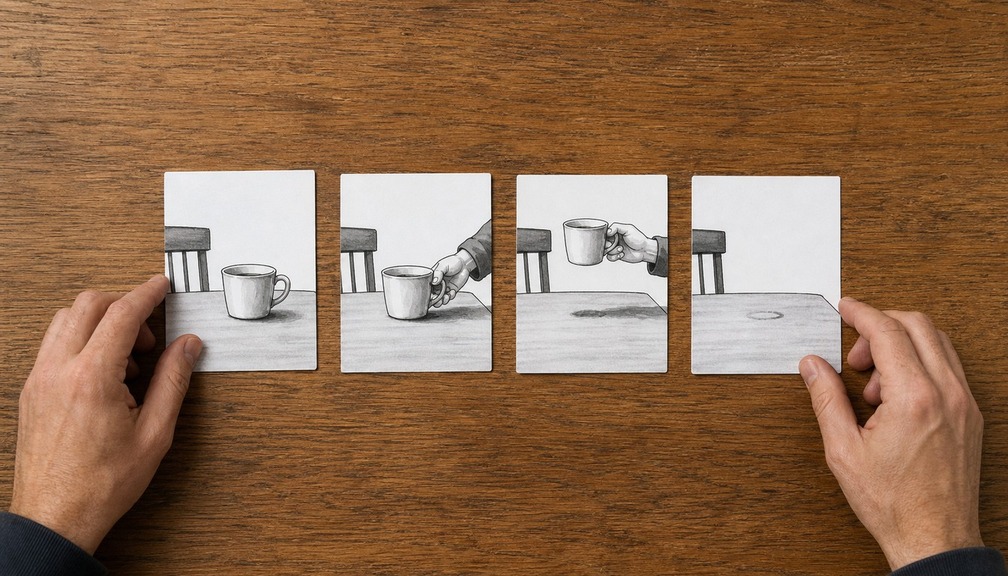
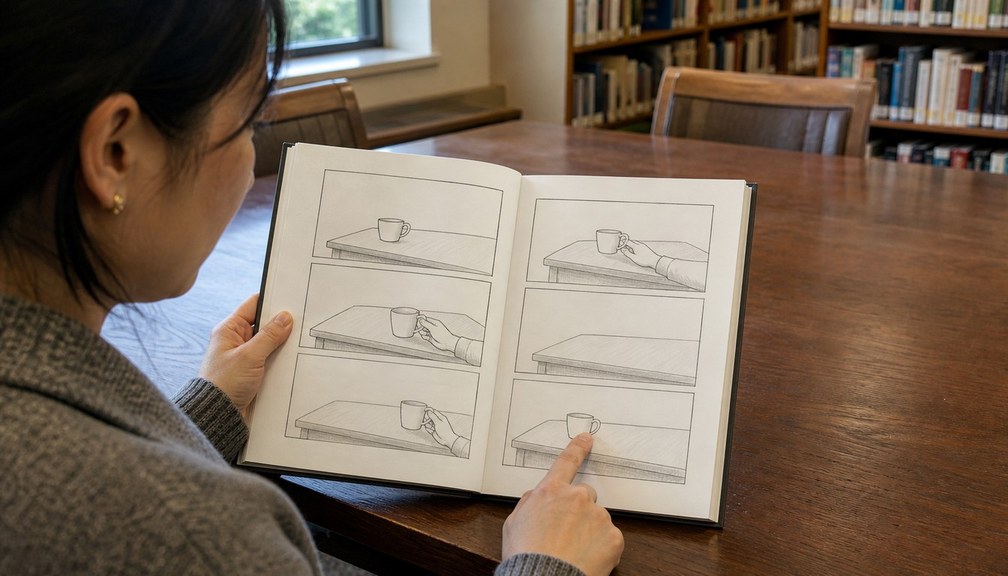
Practice with four wordless cards: first, two people sit at a table with a cup near the edge; next, an arm reaches past it; then, the cup lies on the floor as liquid spreads; finally, someone reaches for a towel. Establish that order before deciding exactly what occurred. Balloon placement and conversational sense can help when a grouping is ambiguous, but they should agree with the edition’s direction and visible relationships. A 2025 eye-tracking study of 90 novice and experienced readers using one textless Watchmen page found that a Z-shaped route described the aggregate left-to-right pattern, yet individual paths varied and returns to earlier panels were common. Use the Z as a prototype, not a command.
What happens between one panel and the next?
What happens between panels is the smallest change that the adjacent images and story context support. Begin by treating each panel as a window of attention. One may establish a room, another may isolate a person or object, and another may emphasize an action, result, or reaction. Those functions often create a sequence resembling setup, initiation, culmination, and aftermath, but that is a set of useful questions rather than a mandatory formula. A comic can omit one role, repeat another, nest a smaller sequence inside a larger one, or let a single panel perform more than one job. Compare visible states before naming the missing event.
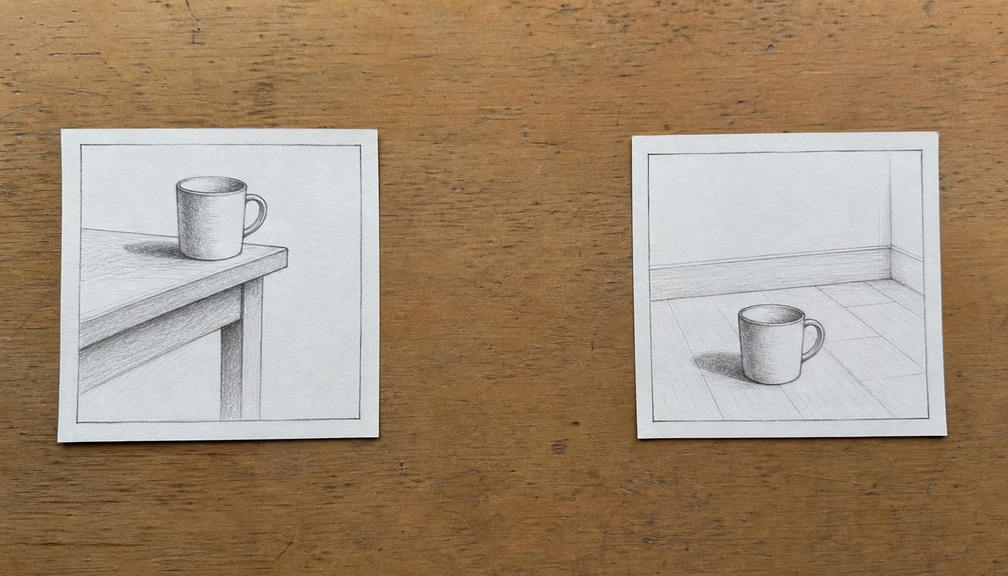
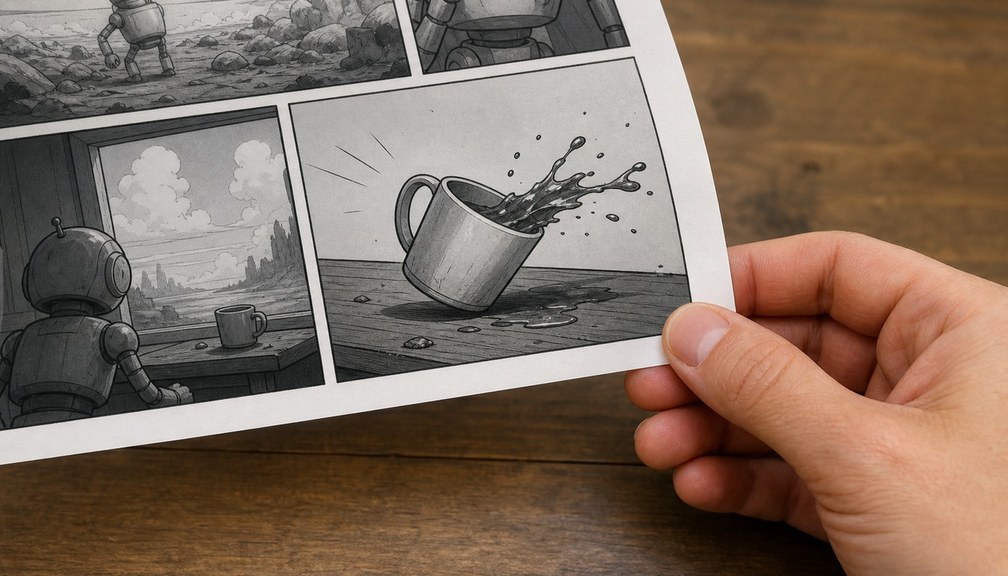
A gutter is the visible space between panels, not a container with one fixed meaning or duration. In the cup sequence, one image shows the cup near the table edge and a later image shows it on the floor with liquid spreading. The restrained bridge is that the cup fell or was knocked down. Nothing in those two images alone identifies who caused it, whether it was deliberate, or precisely how much time passed. Research on visual inference supports reconstructing an omitted event from cues before and after it, while keeping that reconstruction constrained by evidence. Other transitions may indicate elapsed time, a changed viewpoint, a new place, or a thematic comparison instead of missing physical action.
Read for clarity first; let the page teach you its grammar.
How do balloons, captions, and sound effects guide the reading?
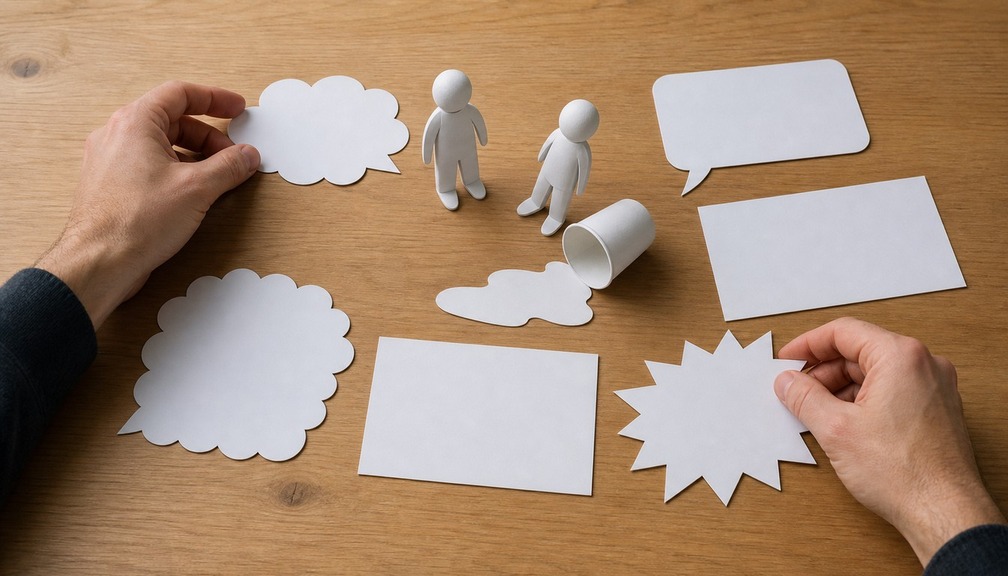
Balloons, captions, and sound effects guide the reading by connecting language or sound to a speaker, thinker, narrator, environment, or reader. First locate the text-bearing shape or free-standing letters. Then trace any tail or trail toward its likely source and test that link against faces, gestures, turn-taking, and scene context. In the table scene, a tail leading to one seated figure suggests audible speech; a thought form can present private language; a reader-facing caption can frame the moment; an off-panel form can place a voice beyond the frame; and impact lettering can make the cup’s fall part of the composition. The relationship matters more than memorizing the label.
Read words and pictures as interacting channels because either one may locate, qualify, extend, or contradict the other. A caption that sounds calm can sit above an alarming image; a face can undermine confident dialogue; a sound effect can draw the eye toward an event outside the conversational exchange. Shape, border, size, weight, and placement can suggest loudness, whispering, distress, transmission, emphasis, or the texture of a sound. These are conventions, not a universal code. Professional lettering guidance explicitly recognizes editorial variation and deliberate rule bending, while semiotic research shows that similar graphic forms can serve different functions. Let each work establish its vocabulary, then verify uncertain cues against the scene.
Common lettering cues and the evidence that should confirm them
Text form
Visible cue
Likely function
What context must confirm
Speech
A balloon with a tail aimed toward a figure
Audible dialogue in the depicted scene
The tail, mouth, gesture, and conversational turn point to the same speaker
Thought
A cloudlike form or trail associated with a figure
Private language not heard by other characters
The work uses that form consistently and the scene treats the words as private
Narration or internal caption
A rectangular or otherwise detached text container
Reader-facing narration, time, place, or internal language
Voice, tense, placement, and surrounding panels clarify who addresses whom
Off-panel or transmitted voice
A tail leaving the frame or a distinct border style
Speech from outside the image or through a device
Reactions, setting, and the work’s established lettering distinguish distance from transmission
Sound effect
Free-standing or stylized letters integrated with the image
An environmental sound or impact
Placement, scale, shape, and the depicted event identify the sound’s source and force
How does the page control emphasis and felt pace?
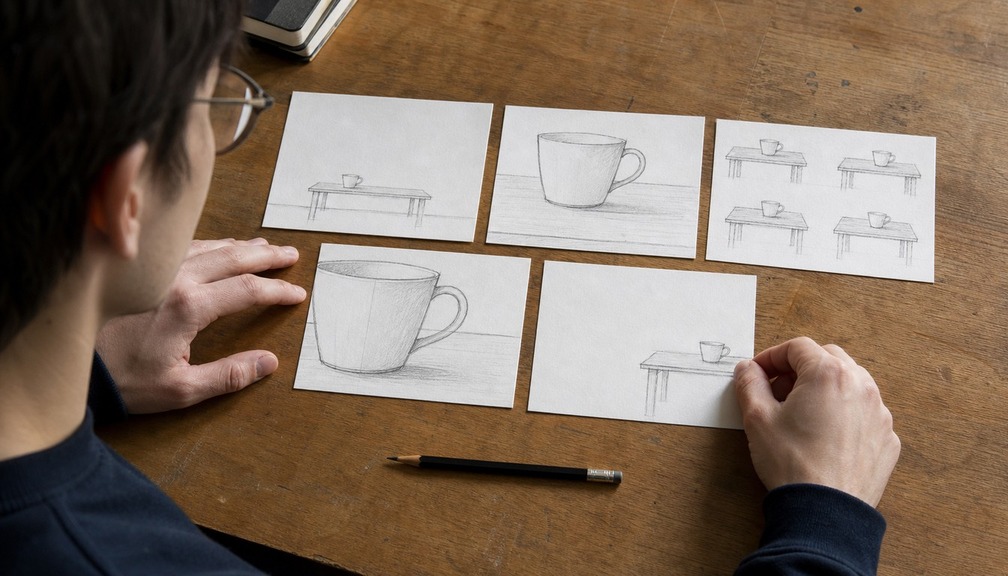
The page controls emphasis and felt pace through several cues working together, including framing, panel count, scale, density, repetition, silence, and story content. A wide view of the table establishes the people and their surroundings. A closer frame selects the cup near the edge, making it harder to overlook. Repeating a view of spreading liquid can hold attention on the result, while a dense cluster of small frames can divide an event into more visual steps. None of these choices supplies an exact duration by itself. Research on visual narrative shows that reframing or dividing a recognizable scene can alter pacing and layout, but content and the reader’s attention remain part of the effect.
Scan within panels as well as between them. Follow a character’s gaze, the direction of an arm, foreground and background placement, repeated shapes, and the position of words relative to faces or objects. In the practice sequence, the cup’s repeated outline can connect the wide view, the reaching arm, and the spill even before you name the action. Then step back and compare how the frames occupy the page. A corpus of 60 comics documented systematic variation in vertical and horizontal segmentation, whole-row panels, bleeds, staggering, separation, and overlap. Treat a dominant image, inset, irregular gap, or overlap as a relationship to interpret in context, not as an automatic command with one meaning.
What makes a page turn feel like a reveal?
A printed page turn feels like a reveal when the current page raises a question and the paper physically keeps the answer out of sight. End the cup sequence’s visible page with the cup beginning to tip. Place the fallen cup and the characters’ reactions on the next page. Until the reader turns, those later images remain unavailable, so the reader’s hand becomes part of the delay and disclosure. The setup might instead be an approaching figure, an unexplained reaction, or a threat that has not entered the frame. Concealment creates the opportunity for suspense, but it does not prescribe an exact emotion, demand a calculated pause, or make every last panel a cliffhanger.
The mechanism changes with the format because visibility changes. When a two-page spread appears at once, the seam and both pages can participate in one composition; the right-hand image is not necessarily concealed in the same way. A screen may reveal material through a swipe, a guided-view transition, or continued vertical scrolling. Each interface controls what remains outside the reader’s view and when it becomes available, but none should be treated as a paper turn in disguise. If a final beat feels like a setup, pause long enough to register the open question, then advance naturally. The useful reading question is simply: what information is being withheld, and what action will bring it into view?
When should you look back at the page?
Look back whenever a speaker, action, repeated image, or route becomes clearer after you have moved forward. On the first pass, prioritize orientation: establish the path, identify who or what supplies each piece of language or sound, and track the visible changes. On a short second pass through the cup sequence, confirm any uncertain speaker, compare the evidence before and after the fall, and notice the cup’s repeated shape, the characters’ gazes, background continuity, silence, and shifts in framing. Eye-tracking research has observed readers returning to earlier panels, although it does not assign every return the same purpose. Backward movement is compatible with reading comics, not evidence that you have done it wrong.
Finish with one whole-page glance because local panel meaning and page-level composition work together. Ask whether one shape echoes across several frames, whether a quiet image interrupts a dense exchange, and whether the final beat prepares a turn, spread, swipe, or scroll reveal. This second pass should be brief unless the page rewards a longer stay. You do not need to decode every border, classify every transition, or use technical vocabulary while reading. Follow clarity first, revise an inference when later evidence requires it, and allow the conventions of panels, gutters, lettering, and reveals to become intuitive through repeated encounters with different books. The page is teaching you how it wants to be read.
Frequently asked questions about reading comics
How do you know which comic panel to read first?
Check the edition’s reading-direction note, then scan the rows, columns, borders, gaps, overlaps, and dominant images. A conventional English-language page often begins at the upper left, while many manga editions retain a right-to-left route. Let the specific layout and story context resolve any exception.
What are gutters in comics?
Gutters are the visible spaces between panels. The neighboring images and story context may imply action, elapsed time, a change of place, a changed viewpoint, or another relationship across that space. A gutter does not carry one fixed meaning or measurable duration.
How do you tell which speech balloon comes first?
Begin with the page’s intended direction and compare the balloons’ relative height and position. Trace each tail toward its likely speaker, then test the order against turn-taking, facial expressions, gestures, and conversational sense. Creators can vary conventional placement, so context settles genuine ambiguity.
How do comics tell stories without showing every action?
Comics select particular states and let readers connect them using visible evidence and story context. If one panel shows a cup at the table edge and another shows it on the floor, the supported bridge is that it fell or was knocked down. Do not invent a culprit unless the sequence supplies one.
Why do comic page turns create suspense?
A printed page can pose a question while keeping the next image physically concealed until the turn. That delay makes the reader’s action part of the reveal. Spreads, swipes, guided view, and vertical scrolling manage visibility differently, so their suspense depends on what each format withholds and when it appears.
References & Sources
This article was researched using the following sources:
We write the reading guides we wanted and could not find. Our recommendations lean on reputable sources and bibliographic records, and we say plainly when something is a matter of taste. AI assists with research and drafting, and every guide is checked against its sources before it goes out.
Choose a fiction point of view by comparing voice, knowledge, distance, and practical costs through carefully controlled rewrites of one dramatic scene.
Compare six mystery and crime-fiction entry points by tone, intensity, investigative method, and driving question to find the experience that fits you.